The History of Crossword Puzzles: From 1913 to AI
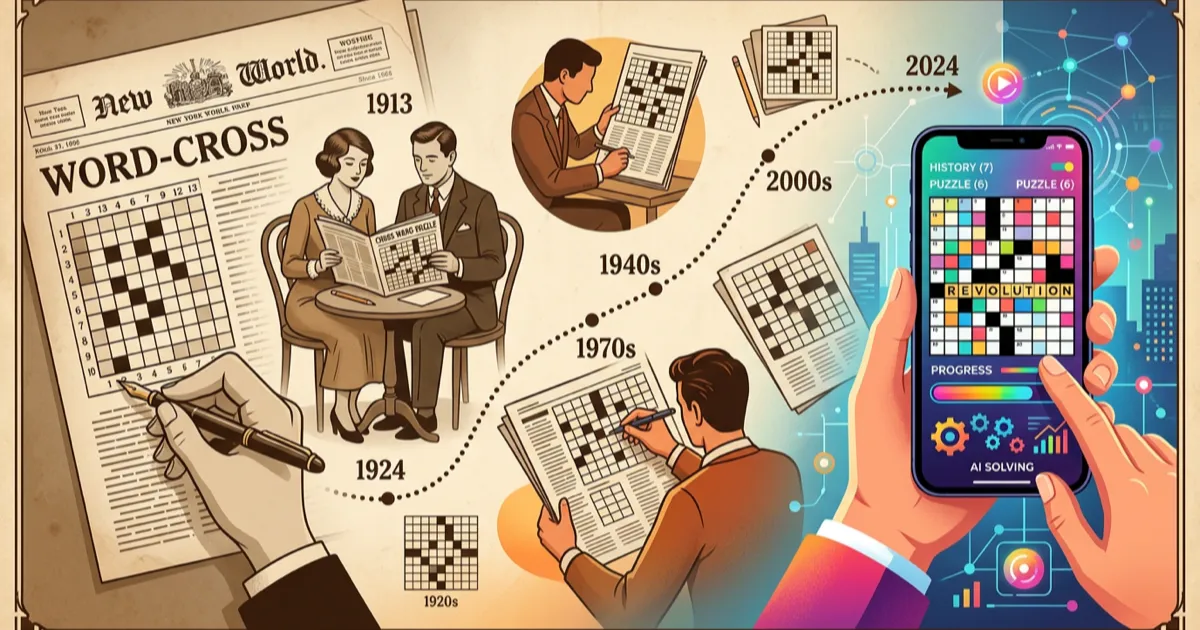
The crossword puzzle is one of the most enduring inventions of the 20th century. From a single diamond-shaped grid in a New York newspaper to AI-generated puzzles on smartphones, the crossword has been reinvented in every era while remaining fundamentally the same: clues, answers, and the satisfying click of letters falling into place.
Here's how it happened.
1913: The First Crossword
On December 21, 1913, Arthur Wynne published a puzzle in the Sunday supplement of the New York World newspaper. He called it a "word-cross." The grid was diamond-shaped, had no black squares, and the clues were simple definitions.
Wynne was a journalist from Liverpool, England, who had emigrated to the United States. He drew inspiration from word squares — an ancient word game where the same words read both across and down — and expanded the concept into an asymmetric grid with distinct Across and Down clues.
The puzzle was an immediate hit with readers. Within weeks, the New York World was receiving letters demanding more. A typesetting error soon renamed it from "word-cross" to "cross-word," and the name stuck.
1920s: The Crossword Craze
By the early 1920s, crossword puzzles had spread to newspapers across America. In 1924, Simon & Schuster published the first book of crossword puzzles — with a pencil attached to each copy. It became a bestseller.
The craze was intense. The New York Times reported on "crossword puzzle addiction." A Broadway show featured a song called "Cross Word Puzzle." Railroads placed dictionaries in their dining cars so passengers could solve during rides. A Chicago woman sued her husband for divorce, citing his crossword obsession.
During this decade, the basic conventions we know today were established:
- Black squares to separate words (replacing Wynne's open diamond)
- Symmetry — the grid pattern looks the same rotated 180°
- Numbering system — sequential numbers for clue references
- Across and Down as standard directional labels
1930s: Standardization
The 1930s brought standardization and quality. Margaret Petherbridge (later Margaret Farrar) became the leading crossword editor, establishing rules that still apply:
- Every white square must be part of both an Across and a Down answer ("fully checked")
- Minimum word length of 3 letters
- No two-letter words
- Grid symmetry is expected
- Clues should be fair and unambiguous
These rules transformed crosswords from a casual diversion into a structured art form.
1942: The New York Times Enters
The New York Times had stubbornly refused to publish crosswords, calling them a "primitive form of mental exercise" and a "sinful waste of time." The paper reversed course on February 15, 1942 — roughly three months after Pearl Harbor — reasoning that Americans needed a morale boost and a mental escape.
Margaret Farrar became the first crossword editor. Under her leadership (1942-1969), the NYT crossword became the gold standard. She established the Monday-through-Saturday difficulty progression and insisted on high editorial quality.
Her successors continued the tradition:
- Will Weng (1969-1977) — introduced humor and pop culture
- Eugene Maleska (1977-1993) — classical, erudite style
- Will Shortz (1993-present) — modernized clues, embraced contemporary culture, made the crossword a pop culture phenomenon
1950s-1980s: The British Cryptic Tradition
While American crosswords developed one direction, British crosswords developed another entirely. British "cryptic" crosswords, popularized by setters like Ximenes and Araucaria, use clues that contain both a definition and wordplay (anagram, reversal, hidden word, etc.).
Example: "Rearrange cinema to find something magical" → ICEMAN? No — CINEMA anagrammed = ICEMAN? Actually → MAGIC? The cryptic tradition created a parallel crossword culture that remains distinct to this day.
1990s: Computers Enter Construction
The 1990s brought computer-assisted crossword construction. Software like Crossword Compiler and Across Lite allowed constructors to:
- Test grid patterns for fill-ability before committing
- Access word databases to find options for difficult grid sections
- Submit puzzles electronically
- Solve puzzles on screen instead of paper
This democratized construction — you no longer needed years of experience to build a publishable grid.
2000s: The Digital Shift
The internet transformed how people solved crosswords:
- Online solving via newspaper websites (NYT, LA Times, WSJ)
- Crossword communities discussing daily puzzles (Rex Parker's blog, Crossword Fiend)
- Mobile apps bringing crosswords to phones and tablets
- Social sharing of solving times and streaks
- Digital archives making decades of puzzles instantly accessible
The NYT Crossword app, launched in its modern form in the 2010s, became one of the most successful subscription apps in the App Store.
2014: Wordle's Grandfather Moment
While Wordle didn't arrive until 2021, the mid-2010s saw an explosion of daily word games inspired by crossword mechanics: mini crosswords, word searches, and puzzle subscriptions. The NYT Mini crossword (5×5, free) introduced millions of new solvers to the crossword format.
2020s: AI Generation
The latest chapter in crossword history is AI-powered puzzle generation. For over a century, every crossword was constructed by a human. AI changes that:
- 2023-2024: Large language models become capable of generating thematically coherent crossword clues
- 2025-2026: Grid Genius launches AI-generated crosswords on any topic using Google Gemini, producing unique puzzles in under 30 seconds
AI generation doesn't replace human construction — the best hand-crafted puzzles (like the NYT's themed Thursday gimmicks) remain beyond AI's reach. But AI enables something new: personalized crosswords on any topic, instantly, infinitely. A student can generate a biology crossword for exam prep. A teacher can create a vocabulary quiz in seconds. A sports fan can solve a puzzle about last night's game.
The crossword has been reinvented for the AI era while keeping everything that made it great: clues, answers, crossing letters, and the satisfaction of filling in that last square.
Try a Modern AI CrosswordThe Numbers
- 1913: First crossword puzzle published
- 1924: First crossword puzzle book (Simon & Schuster)
- 1942: NYT publishes first crossword
- 50+ million: Estimated crossword solvers in the US today
- $40+ million: Annual revenue from NYT Games subscription
- 113 years: The crossword puzzle has been entertaining humans
Be part of crossword history
Try the latest evolution — AI-generated crosswords on any topic you choose.
Play NowReady to play?
AI-generated crossword puzzles on any topic — with smart AI hints that help you think, not just give away answers. Free to play, no sign-up required.
Start Playing Free