Daily Crossword Puzzles: Why a Daily Habit Makes You Sharper
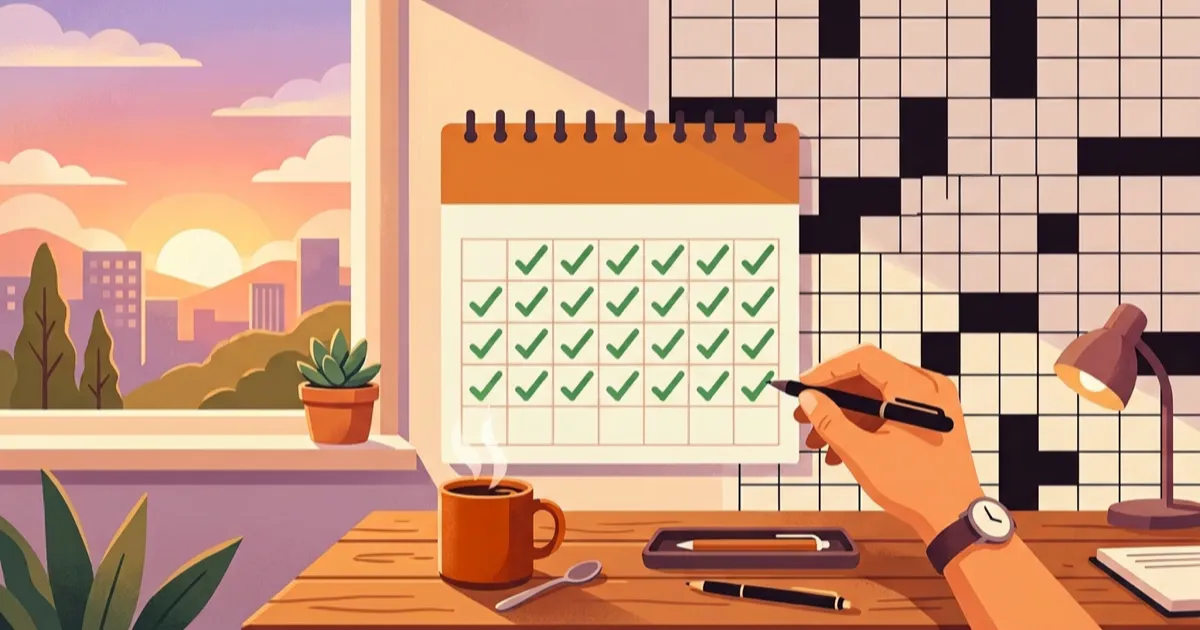
The most effective brain exercise isn't a one-time marathon — it's a daily habit. And crossword puzzles happen to be one of the best daily habits you can build.
Here's why daily solving works, how to build the habit, and what you can expect.
Why Daily Matters More Than Occasional
The spacing effect
Cognitive science has established the "spacing effect" — information reviewed at regular intervals is retained far better than information crammed in a single session. A daily crossword creates exactly this pattern: you retrieve vocabulary, exercise pattern recognition, and practice lateral thinking every single day.
Cumulative vocabulary growth
Every crossword teaches you a few new words or word patterns. Solve one puzzle and you learn 2-3 new terms. Solve daily for a month and you've added 60-90 words to your active vocabulary. Over a year, that's 700+ new words — the equivalent of learning a new language at conversational level.
Neural pathway maintenance
The brain follows a "use it or lose it" principle. Research from Duke and Columbia shows that regular crossword solving maintains neural pathways in the hippocampus and cortex — areas critical for memory and language. Daily practice keeps these pathways active and strong.
The Grid Genius Daily Challenge
Every day at midnight UTC, Grid Genius publishes a new daily challenge puzzle. Here's what makes it effective for building a habit:
Same puzzle for everyone
Every solver worldwide gets the same daily puzzle. This creates a shared experience — you can compare your time and accuracy with friends, family, and the global community.
Global leaderboard
Each daily puzzle has a leaderboard ranked by speed, accuracy, and hint usage. Seeing your rank compared to other solvers adds a competitive motivation that pure solo solving doesn't have.
Streak tracking with milestones
Grid Genius tracks your daily solving streak — how many consecutive days you've completed the challenge. Milestone badges mark your progress:
| Streak | Badge | Meaning |
|---|---|---|
| 3 days | Getting Started | You've begun |
| 7 days | Week Warrior | One full week |
| 14 days | Fortnight Force | Two weeks strong |
| 30 days | Monthly Master | A month of daily solving |
| 60 days | Double Down | Two months consistent |
| 90 days | Quarter Champ | A full quarter |
| 180 days | Half-Year Hero | Six months of dedication |
| 365 days | Year of Genius | A full year — exceptional |
The badge system turns consistency into visible progress. Breaking a streak feels like losing something real, which is a powerful motivator for maintaining the habit.
Free — no subscription needed
The daily challenge is completely free. No account required, no paywall. Just open Grid Genius and start solving.
Play Today's Daily ChallengeHow to Build a Daily Crossword Habit
1. Anchor it to an existing routine
The most reliable way to build any new habit is to attach it to something you already do every day. Common anchors:
- Morning coffee: Solve while your coffee brews or while drinking it
- Commute: Solve on the train, bus, or (as a passenger) in the car
- Lunch break: A 10-minute mental reset between work sessions
- Before bed: A calming wind-down activity instead of scrolling social media
2. Start small
Don't commit to a 15-minute Standard puzzle on day one. Start with the daily challenge on Easy mode, or try Mini (7×7) puzzles that take 3-5 minutes. The goal isn't to challenge yourself maximally — it's to show up every day.
3. Use AI hints to learn, not just solve
Grid Genius's AI Hints don't just reveal the answer — they generate contextual clues that rephrase the original hint or give related facts, helping you think deeper. This means you still get the cognitive benefit of figuring out the answer yourself, with a nudge in the right direction. Much better for brain training than simply revealing letters. Learn more about solving strategies.
4. Track your streak
Pay attention to your streak count and badge progress. When you see "14-day streak" and know the 30-day badge is within reach, you'll find it much harder to skip a day. The streak becomes self-reinforcing.
5. Don't break the chain
Productivity expert Jerry Seinfeld's famous advice: "Don't break the chain." Each day you solve adds a link. The longer the chain, the more motivated you are to protect it. If you miss a day, start a new chain immediately — don't let one missed day become a week.
What to Expect Over Time
Week 1-2: Building the routine
You're establishing the habit loop: cue (morning coffee) → routine (solve daily puzzle) → reward (streak counter increases). Puzzles feel challenging. You use hints frequently. That's normal.
Month 1: Vocabulary growth kicks in
You start recognizing "crosswordese" — those common short words (ERA, ORE, ARIA, ALOE) that appear in almost every puzzle. Your solving speed noticeably improves. You need fewer hints.
Month 3: Pattern recognition
You begin reading clues differently. You recognize that "?" means wordplay, "(abbr.)" means abbreviation, and past-tense clues mean past-tense answers. Solving feels more like a skill and less like guessing.
Month 6: Confidence to increase difficulty
Easy puzzles feel routine. You comfortably move to Medium, and Hard no longer feels impossible. Your vocabulary has grown by hundreds of words.
Year 1: Mastery
A 365-day streak is a genuine accomplishment. Your solving speed is dramatically faster than when you started. You can tackle Hard puzzles on unfamiliar topics. Crosswords have become a natural part of your day — not a task, but something you look forward to.
Daily Crossword vs. Weekly Crossword
Some people argue that one challenging crossword per week is enough. The science disagrees:
- Memory consolidation requires regular repetition. Daily exposure to word patterns builds permanent neural pathways; weekly exposure requires more relearning each session.
- Vocabulary accumulation is faster with daily solving. 7 puzzles per week × 2-3 new words = 14-21 new words weekly, versus 2-3 from a single weekly puzzle.
- Habit formation is easier with daily practice. Research shows it takes an average of 66 days to form a new habit — daily repetition gets you there; weekly doesn't.
The ideal daily session is 5-15 minutes. That's less time than most people spend on social media in a single session.
Compete While You Build
Grid Genius's global leaderboard adds a dimension that solo solving doesn't have. Each daily puzzle ranks all solvers by:
- Speed: How quickly you completed the puzzle
- Accuracy: Whether you had errors
- Hint usage: Fewer hints means higher score
- Difficulty multiplier: Harder puzzles score higher
You can see daily, weekly, monthly, and all-time rankings. Watching your rank improve over weeks and months is tangible proof that your daily habit is working.
Start Today
The best day to start a daily crossword habit is today. The second best day is tomorrow. But today is better.
Start your streak
A new puzzle every day at midnight UTC. Free to play. Compete globally.
Play Today's Daily PuzzleReady to play?
AI-generated crossword puzzles on any topic — with smart AI hints that help you think, not just give away answers. Free to play, no sign-up required.
Start Playing Free