Crossword Puzzles vs Wordle: Which Word Game Is Better for You?
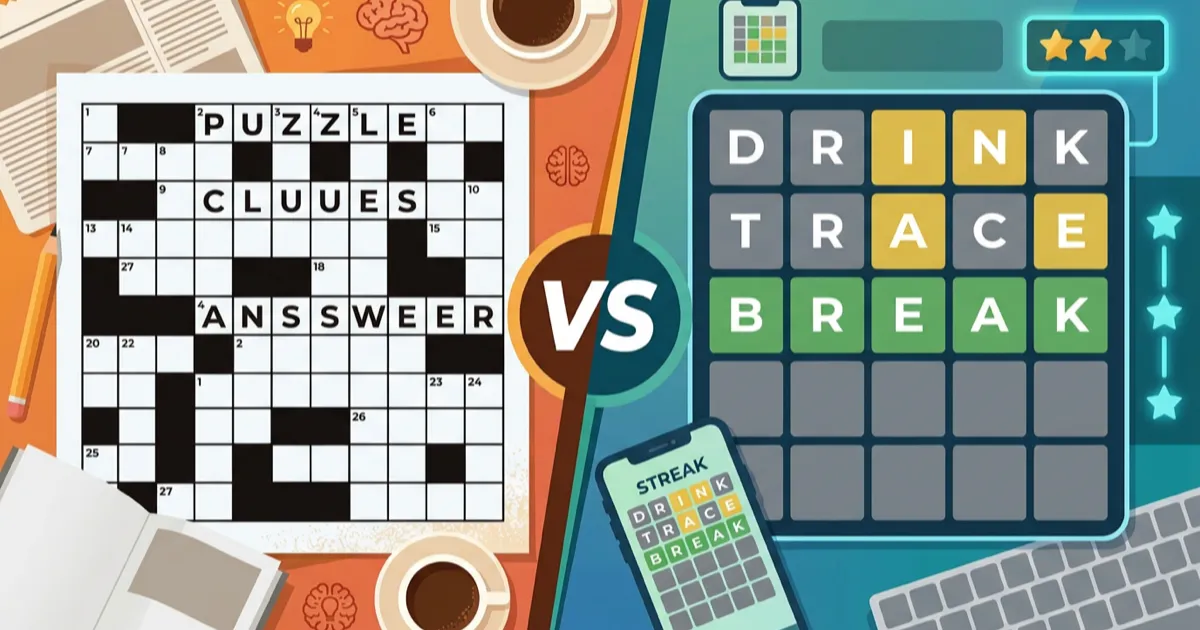
Wordle exploded in popularity in 2022 and introduced millions of people to daily word games. Crossword puzzles have been a daily ritual for over a century. Both are word games, both are daily habits, and both have passionate communities.
But they're fundamentally different games. Here's how they compare — and why you might want both.
Quick Comparison
| Feature | Crossword Puzzles | Wordle |
|---|---|---|
| Format | Grid of intersecting words with clues | Guess a single 5-letter word in 6 tries |
| Daily time | 5-30 minutes | 2-5 minutes |
| Skill type | Vocabulary, knowledge, pattern recognition | Letter elimination, pattern logic |
| Difficulty range | Easy to extremely hard | One fixed difficulty |
| Topics | Any subject (customizable) | Random English words |
| Hints available | AI Hints (contextual clues), Reveal Letter, Reveal Word | Color feedback only |
| Guesses/attempts | Unlimited (fill and erase) | 6 attempts maximum |
| Social sharing | Share puzzles + playable links | Share colored grid results |
| Free daily puzzle | Yes (Grid Genius, NYT Mini) | Yes (NYT Wordle) |
| Unlimited play | Yes (with subscription) | One puzzle per day |
How the Gameplay Differs
Crosswords: Knowledge + Deduction
A crossword gives you clues and asks you to retrieve the right word from your vocabulary. "Opera solo" → ARIA. "Fencing sword" → EPEE. You either know the answer or you use crossing letters to figure it out.
The magic is in the intersections — every correct answer gives you letters that help solve other words. A crossword starts hard and gets progressively easier as you fill in more answers.
What it exercises: Vocabulary breadth, semantic memory retrieval, general knowledge, pattern matching from partial information.
Wordle: Logic + Elimination
Wordle gives you no clues — just six chances to guess a 5-letter word. Each guess reveals which letters are correct (green), present but misplaced (yellow), or absent (gray). You narrow down possibilities through elimination.
The strategy is choosing words that maximize information. A good opening word (like CRANE or SLATE) tests common letters. Each subsequent guess uses the feedback to converge on the answer.
What it exercises: Letter-frequency intuition, elimination logic, strategic thinking, 5-letter word vocabulary.
Brain Benefits
Crosswords: Broader cognitive workout
Research from Duke and Columbia shows crosswords outperform computer-based brain games at improving memory and cognitive function. Crosswords engage multiple brain regions simultaneously:
- Semantic memory: Retrieving word meanings from long-term storage
- Language processing: Parsing clues, understanding wordplay
- Pattern recognition: Using partial letters to identify words
- Working memory: Holding multiple partial answers simultaneously
- Cognitive flexibility: Switching between literal and figurative clue interpretations
Wordle: Focused logic exercise
Wordle primarily exercises:
- Elimination logic: Narrowing possibilities from feedback
- Letter-frequency knowledge: Knowing which letters are common in English
- Strategic thinking: Choosing guesses that maximize information
Wordle is a strong logic exercise, but it's narrower than crosswords. The vocabulary requirement is limited to 5-letter words, and there are no clues to parse or knowledge domains to draw from.
Verdict: For brain health, crosswords provide a more comprehensive workout. For pure logic and pattern elimination, Wordle is excellent.
Time Commitment
Wordle: 2-5 minutes. One puzzle per day. Done.
Crossword (Mini): 3-5 minutes. Quick and comparable to Wordle.
Crossword (Standard): 10-30 minutes. A more substantial session.
Crossword (Large/Hard): 30-60+ minutes. A deep engagement.
If you only have 5 minutes, Wordle or a mini crossword both fit. If you want a deeper daily mental exercise, a standard crossword offers more.
Social and Community
Wordle's social genius
Wordle's colored grid sharing (no spoilers!) was a viral innovation. Sharing your result — ⬛🟨🟩🟩🟩 — became a daily social ritual. Everyone plays the same puzzle, so results are instantly comparable.
Crossword communities
Crossword communities are deeper but less viral. Rex Parker's daily NYT analysis, crossword Twitter, and solving-time comparisons create an engaged community. Grid Genius adds global leaderboards to the mix — you can compare your daily solving time with everyone worldwide.
Crossword sharing
Grid Genius lets you create and share custom crosswords via playable links. This goes beyond comparing results — you can create a puzzle for friends, family, or your classroom and share it directly. Teachers use this for vocabulary quizzes, and event planners create personalized puzzles.
The Case for Both
The best word game routine includes both:
Morning: Wordle (2 minutes) — a quick logic warm-up Coffee break: Grid Genius daily crossword (10-15 minutes) — deeper vocabulary and knowledge workout
They exercise different cognitive skills and take different amounts of time. Wordle is a sprint; a crossword is a jog. Both are valuable.
If You Like Wordle, Try These
Already hooked on Wordle? Here's how to ease into crosswords:
- Start with Easy Mini crosswords — Grid Genius's 7×7 Easy puzzles are comparable in time and difficulty to Wordle
- Pick a topic you know — A crossword about your favorite topic is easier than a general-knowledge puzzle
- Use hints freely — Hints aren't cheating, they're learning tools
- Build a daily streak — Grid Genius tracks streaks with badges, just like Wordle's streak counter
Add crosswords to your daily word game routine
Free daily challenge, global leaderboard, streak tracking. Takes 10 minutes.
Play Today's PuzzleReady to play?
AI-generated crossword puzzles on any topic — with smart AI hints that help you think, not just give away answers. Free to play, no sign-up required.
Start Playing Free