Crossword Puzzles vs Sudoku: Which Is Better for Your Brain?
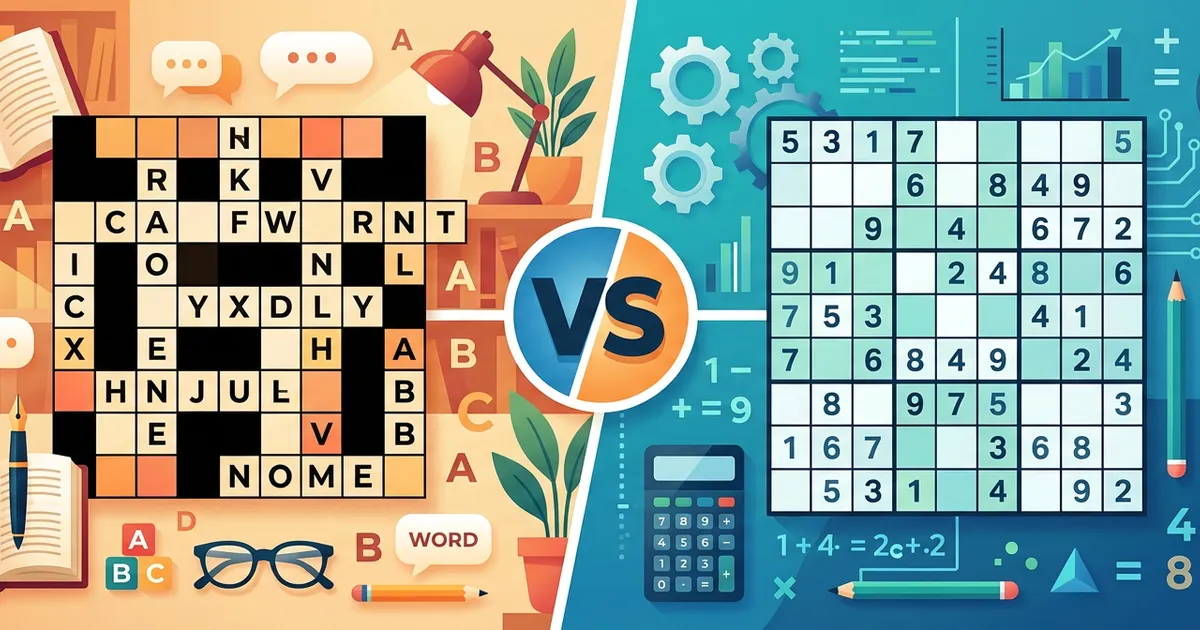
Crosswords and Sudoku are the two most popular puzzle types in the world. Both claim to keep your brain sharp, both have dedicated daily audiences, and both fit into a coffee break. But they exercise fundamentally different cognitive skills.
Here's an honest comparison to help you decide which to prioritize — or why you should do both.
How They Work (Quick Refresher)
Crossword puzzles
Fill a grid of white and black squares with words. Across and Down clues hint at each answer. Words intersect, sharing letters at crossing points. Correct answers help solve crossing words.
Sudoku
Fill a 9×9 grid with the numbers 1-9. Every row, column, and 3×3 box must contain each digit exactly once. No clues — just logic and elimination from the given numbers.
Head-to-Head Comparison
| Feature | Crossword Puzzles | Sudoku |
|---|---|---|
| Primary skill | Language + knowledge | Logic + spatial reasoning |
| Knowledge needed | Yes (vocabulary, trivia, culture) | No (pure logic) |
| Language barrier | Yes (language-specific) | No (numbers are universal) |
| Difficulty range | Easy to extremely hard | Easy to extremely hard |
| Time per puzzle | 5-60 min (varies by size) | 5-30 min (varies by difficulty) |
| Topic variety | Unlimited (any subject) | None (always numbers) |
| Daily habit | Free daily challenges available | Widely available free |
| Research backing | Strong (RCTs from Duke/Columbia) | Moderate (observational studies) |
| Hints available | AI Hints, Reveal Letter, Reveal Word | Pencil marks, candidate elimination |
| Social/sharing | Create and share custom puzzles | Standard format only |
| Noise tolerance | Moderate (need to read clues) | High (visual only) |
Cognitive Benefits: What Each Exercises
Crosswords exercise verbal-linguistic intelligence
When you solve a crossword, your brain is doing several things simultaneously:
- Semantic memory retrieval: Searching your vocabulary for a word that matches the clue. "Capital of France" → scanning your geographic knowledge → PARIS.
- Language processing: Parsing the clue's meaning, detecting wordplay, understanding misdirection.
- Pattern recognition: Using partial letters (
_A_E_) to narrow possibilities. - Working memory: Holding multiple unsolved clues and partial answers in mind while solving others.
- Cognitive flexibility: Switching between literal interpretations and figurative ones (especially for "?" clues).
Research from Duke and Columbia universities found crosswords outperformed computer-based brain training games at improving memory and slowing brain shrinkage in adults with mild cognitive impairment.
Sudoku exercises logical-mathematical intelligence
When you solve a Sudoku, your brain focuses on:
- Deductive reasoning: If row 1 already has 3, 5, and 7, then this empty cell can't be any of those.
- Spatial pattern recognition: Recognizing which cells in a box/row/column are constrained.
- Working memory: Tracking candidates (possible numbers) for multiple cells simultaneously.
- Sequential logic: Building chains of deductions — "if this cell is 4, then that cell must be 7, which means..."
Sudoku studies show improvements in logical reasoning and processing speed, though the research base is smaller and less rigorous than for crosswords.
The key difference
Crosswords are convergent — every clue has one right answer, and you find it through knowledge plus deduction. Sudoku is purely deductive — no knowledge required, just logic applied to constraints.
This means crosswords build your vocabulary and general knowledge over time (you learn new words, facts, and cultural references). Sudoku builds your logical reasoning ability. Both strengthen working memory.
When to Choose Crosswords
- You want the broadest cognitive workout: Crosswords engage more brain regions simultaneously.
- You want to learn while you solve: Every crossword teaches new vocabulary and facts.
- You want topic variety: Today science, tomorrow sports, next week pop culture. Sudoku is always numbers.
- You want to create puzzles for others: Grid Genius's free Word List Builder lets you make custom crosswords. There's no equivalent for custom Sudoku.
- You want AI assistance: Grid Genius's AI Hints generate contextual clues that help you think through answers — a learning tool built into the puzzle.
When to Choose Sudoku
- You don't speak English well: Sudoku is language-independent. Crosswords require vocabulary in a specific language.
- You're in a noisy environment: Sudoku is purely visual. Crosswords require reading and processing text clues.
- You prefer pure logic: If you love math and deduction but find vocabulary frustrating, Sudoku is your puzzle.
- You want consistent difficulty: A "hard" Sudoku is hard for everyone equally. A "hard" crossword depends on your personal knowledge.
The Best of Both Worlds
The optimal daily brain training routine includes both:
| Time | Activity | Cognitive Target |
|---|---|---|
| 5 min | Mini crossword (Easy/Medium) | Verbal, memory, language |
| 5 min | Quick Sudoku (Medium) | Logic, spatial reasoning |
| 10 min total | Comprehensive brain workout | Both verbal and spatial |
This 10-minute daily combo covers the two major cognitive domains. It's more effective than 10 minutes of either alone because you're exercising different neural pathways.
Difficulty Comparison
Easy
- Crossword Easy: Direct definition clues, common vocabulary. Most people can complete without help.
- Sudoku Easy: Many given numbers, straightforward elimination. Most beginners can complete.
- Verdict: Comparable difficulty. Crosswords slightly more accessible due to crossing letter hints.
Medium
- Crossword Medium: Mixed clue styles, moderate vocabulary, some inference required.
- Sudoku Medium: Fewer given numbers, requires candidate tracking and chain logic.
- Verdict: Crosswords depend on your knowledge; Sudoku depends on your logic skill. Different challenges.
Hard
- Crossword Hard: Wordplay, misdirection, specialized vocabulary, minimal gimmes.
- Sudoku Hard: Requires advanced techniques (X-wing, swordfish, XY-wing). Deep chain reasoning.
- Verdict: Both are genuinely difficult. Hard crosswords frustrate with vocabulary gaps. Hard Sudoku frustrates with logical dead ends.
Social and Sharing
Crosswords have a significant advantage here:
- Create custom puzzles: Make crosswords about anything — your friend's birthday, your team's inside jokes, your book club's current read. Multiple creation methods available.
- Share playable links: Anyone can solve your crossword in their browser — no account needed.
- Global leaderboard: Compete with solvers worldwide on Grid Genius daily challenges.
- AI-generated variety: Enter any topic and get a unique puzzle in 30 seconds.
Sudoku is standardized — every puzzle uses the same 1-9 format. There's no personalization, no custom creation, and no topical variety. This is both its strength (universal, consistent) and its limitation (repetitive).
What the Research Says
Crosswords: Strong evidence
The Duke/Columbia randomized controlled trial found crosswords superior to brain training games for memory improvement. The University of Exeter study (19,000+ participants) found crossword solvers performed cognitively equivalent to people 10 years younger.
Sudoku: Moderate evidence
The same University of Exeter study found number puzzle solvers also showed cognitive benefits, though the effect was measured separately from crosswords. The research base for Sudoku specifically is smaller, with fewer randomized controlled trials.
Combined: Best approach
No study has specifically tested crosswords + Sudoku combined, but the theoretical case is strong: training both verbal and spatial cognitive systems provides broader protection than training just one.
If You Love Sudoku, Try Crosswords Too
Already a Sudoku fan? Here's how to ease into crosswords:
- Start with Easy Mini — Grid Genius's 7×7 Easy is the least intimidating entry point
- Choose a topic you know — A crossword about your favorite subject uses vocabulary you already have
- Use AI Hints freely — They help you learn without frustration. Not cheating, just learning.
- Add it to your Sudoku routine — Sudoku first (warm up with logic), then crossword (engage verbal systems)
The skills don't compete — they complement. Strong Sudoku solvers often become good crossword solvers quickly because the deductive reasoning transfers.
Try the other half of brain training
If you do Sudoku, add a daily crossword. AI-generated, any topic, free daily challenge.
Play a CrosswordReady to play?
AI-generated crossword puzzles on any topic — with smart AI hints that help you think, not just give away answers. Free to play, no sign-up required.
Start Playing Free