Crossword Puzzles for Seniors: Keep Your Mind Sharp at Any Age
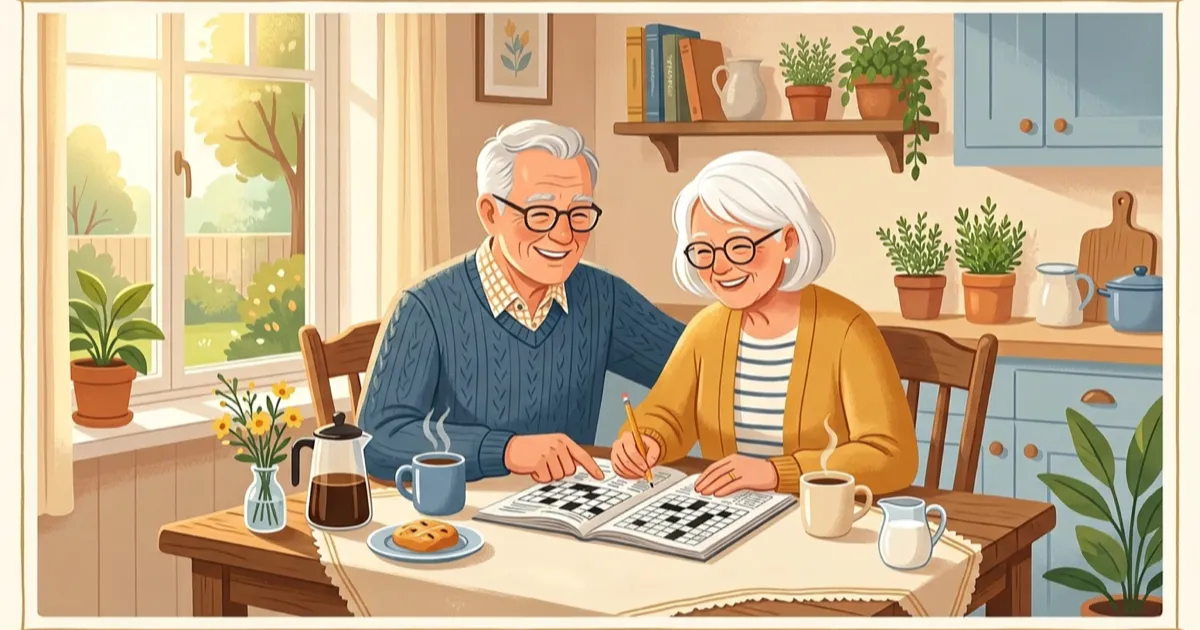
If you're looking for one daily habit that's genuinely good for your brain, crossword puzzles are hard to beat. They're backed by serious research, they're enjoyable rather than tedious, and they fit into any schedule.
Here's what the science says, how to get started (even if you've never solved a crossword), and why a daily habit is worth building. For a deep dive into the research, see our full article on crossword puzzles and brain health.
What the Research Says
Crosswords outperform brain training apps
The most rigorous study on crosswords and cognitive health came from Duke University and Columbia University. Researchers assigned 107 adults (average age 71) with mild cognitive impairment to either web-based crossword puzzles or popular brain training games.
The crossword group performed better on every measure:
- Greater improvement on the ADAS-Cog (the gold-standard cognitive assessment) at both 12 weeks and 78 weeks
- Between 0.5% and 1% less brain shrinkage in the hippocampus (memory center) and cortex over 18 months
- Better daily functioning scores at 78 weeks
The study concluded crossword puzzles were "superior to cognitive games" for this population. Published in the New England Journal of Medicine Evidence.
Earlier onset of decline is delayed
A Columbia University longitudinal study tracking 488 participants found that crossword puzzle engagement delayed the onset of accelerated memory decline by an average of 2.54 years. While all participants eventually experienced some cognitive changes, crossword solvers maintained their baseline function significantly longer.
Brain function equivalent to 10 years younger
The University of Exeter's PROTECT study (19,000+ participants aged 50+) found that regular crossword solvers performed at a level equivalent to people 10 years younger on tests measuring attention, reasoning, and memory.
Why crosswords work
Solving a crossword engages multiple brain systems simultaneously:
- Semantic memory retrieval — searching your vocabulary for the right word
- Language processing — parsing clue meanings, wordplay, and definitions
- Pattern recognition — using crossing letters to narrow down answers
- Working memory — holding multiple partial answers in mind at once
- Cognitive flexibility — switching between literal and figurative interpretations
This multi-system engagement is why crosswords outperform single-purpose brain games — you're exercising more of your brain in a single session.
Getting Started: A Guide for New Solvers
Never solved a crossword before? That's perfectly fine. Here's a gentle on-ramp.
Step 1: Start small and easy
Grid Genius offers Easy difficulty with a Mini (7×7) grid. This means:
- Fewer words (8-12 instead of 30+)
- Common vocabulary (no obscure terms)
- Direct, straightforward clues
- Completable in 5-10 minutes
Don't start with a Saturday NYT puzzle — that's the equivalent of running a marathon on your first day of exercise.
Try a Free Easy PuzzleStep 2: Pick a topic you know
Grid Genius lets you choose from 50+ topics. Start with something familiar:
- Food & Cooking — ingredients, dishes, and kitchen terms you use daily
- Animals — species names everyone knows
- History — major events and famous figures
- Music — genres, instruments, and artists from your era
When you already know the vocabulary, you can focus on learning the mechanics of crossword solving.
Step 3: Use hints without guilt
Grid Genius has a unique AI-powered hint system:
- AI Hint — Instead of revealing the answer, the AI rephrases the clue or gives you a related fact that helps you think deeper. You can ask for multiple AI hints per clue, each progressively more helpful. This is what makes Grid Genius different — it helps you learn, not just complete the puzzle.
- Reveal Letter — Shows one letter in the current square
- Reveal Word — Fills in an entire word (use as a last resort)
- Check Puzzle — Highlights any incorrect letters (always free)
Hints are not cheating. They're learning tools. The AI hints in particular are designed to exercise your brain rather than bypass it — which is exactly what you want for cognitive benefits. Every experienced solver started somewhere.
Step 4: Build a daily routine
The biggest benefit comes from consistency. Anchor your crossword to something you already do:
- With morning coffee — solve while it brews or while drinking it
- After breakfast — a 10-minute mental warm-up before the day
- Before bed — a calming alternative to TV or phone scrolling
- At the doctor's office — beats staring at magazines
Step 5: Track your progress
Grid Genius tracks your daily streak — how many consecutive days you've completed a puzzle. Milestone badges at 7, 14, 30, 60, 90, and 365 days make progress visible. Watching your streak grow is genuinely motivating.
Why the Daily Habit Matters
A weekly crossword is fine. But daily solving amplifies the benefits:
- Memory consolidation requires regular repetition — daily exposure builds permanent neural pathways
- Vocabulary grows faster — 7 puzzles/week means 14-21 new words weekly
- Pattern recognition improves — you start recognizing common crossword conventions
- Habit formation — research shows it takes ~66 days to form a habit; daily practice gets you there
The time commitment is modest: 5-15 minutes per day. That's less than reading the newspaper.
Solving Tips for Seniors
Start with fill-in-the-blank clues
These are the easiest type: "___ of the Wild" → CALL. Scan all clues and answer these first — they give you letters that help with harder clues.
Use crossing letters
If you have _ A _ E R for a 5-letter word, there aren't many options (WATER, PAPER, LASER, CAPER). The more letters you fill in, the easier remaining words become.
Don't go in order
Skip hard clues. Come back to them after you've filled in easier answers nearby. The crossing letters often make a previously impossible clue obvious.
Learn the common crossword words
Some short words appear in almost every crossword: ERA, ORE, ALE, ARIA, ALOE, EPEE, OREO, ANTE. Our crossword glossary lists 35 common terms.
Increase difficulty gradually
Once Easy feels routine, move to Medium. When Medium is comfortable, try Hard. The cognitive benefit comes from working at the edge of your ability — if you're solving without any challenge, it's time to step up.
Print It Out
Not a fan of screens? Grid Genius lets you download any puzzle as a printable image. You get:
- The crossword grid with numbered squares
- Organized clue lists (Across and Down)
- Optional answer key on a separate page
Print it, grab a pencil, and solve at the kitchen table. It's the classic newspaper crossword experience, with any topic you choose.
See our printing guide for step-by-step instructions.
Create Your Own Crossword Puzzles
Grid Genius isn't just for solving — you can create your own puzzles too, completely free:
- For grandkids: Make a crossword with vocabulary from their favorite topics or school subjects. They'll love that Grandma or Grandpa made it just for them.
- For book club: Build a puzzle from characters, themes, and plot points of your current read.
- For community groups: Create crosswords for church groups, social clubs, or retirement communities with shared inside knowledge.
- For memory: Make a crossword about your life — places you've lived, people you've known, experiences you've had. It's a form of reminiscence therapy that doubles as a puzzle.
The Word List Builder lets you enter your own words and clues — the algorithm handles the grid layout. The Freeform Editor gives you full control over where every letter goes. Both are free, no account needed.
Or let AI do the work: enter any topic and Grid Genius generates a complete puzzle — words, clues, and grid — in under 30 seconds. Perfect when you want a fresh puzzle on a specific subject without the manual work.
Create a crossword for someone you love
Enter your words, generate a puzzle, print or share — completely free.
Open Puzzle MakerShare With Friends and Family
Crosswords are better with company:
- Solve together — work on a puzzle with your spouse, a friend, or grandkids
- Challenge each other — compare daily solving times on the leaderboard
- Share digitally — create a playable link that anyone can open on their phone or computer, no app needed
- Gift a custom puzzle — create a crossword for a birthday or anniversary
The social dimension adds another layer of cognitive benefit — social engagement is itself one of the strongest protective factors against cognitive decline.
Grid Genius vs. Newspaper Crosswords
| Feature | Grid Genius | Newspaper Crossword |
|---|---|---|
| Topics | Any topic you choose (AI-generated) | Editor's choice |
| Difficulty | Selectable (Easy/Medium/Hard) | Fixed by day of week |
| Grid sizes | Mini, Standard, Large | One size |
| Hints | AI Hints (contextual clues), Reveal Letter, Reveal Word, Check | None (until you check answers) |
| Create your own | Free puzzle maker (Word List + Freeform + AI) | Not available |
| Availability | 24/7, any device | One per day in print |
| Cost | Free daily challenge | Newspaper subscription |
| Print option | Yes — download and print | Already printed |
| Leaderboard | Global competition | None |
| Streak tracking | Yes, with badges | Manual |
Grid Genius isn't replacing your newspaper crossword — it's a complement. Use Grid Genius for the daily challenge, AI-generated topic puzzles, and the printable puzzle maker. Keep your newspaper crossword for the traditional experience.
Start your daily crossword habit
Free daily challenge. No account required. Easy mode for beginners. Print any puzzle.
Play Your First PuzzleReady to play?
AI-generated crossword puzzles on any topic — with smart AI hints that help you think, not just give away answers. Free to play, no sign-up required.
Start Playing Free