Crossword Puzzles for People Who Think They're Bad at Word Games
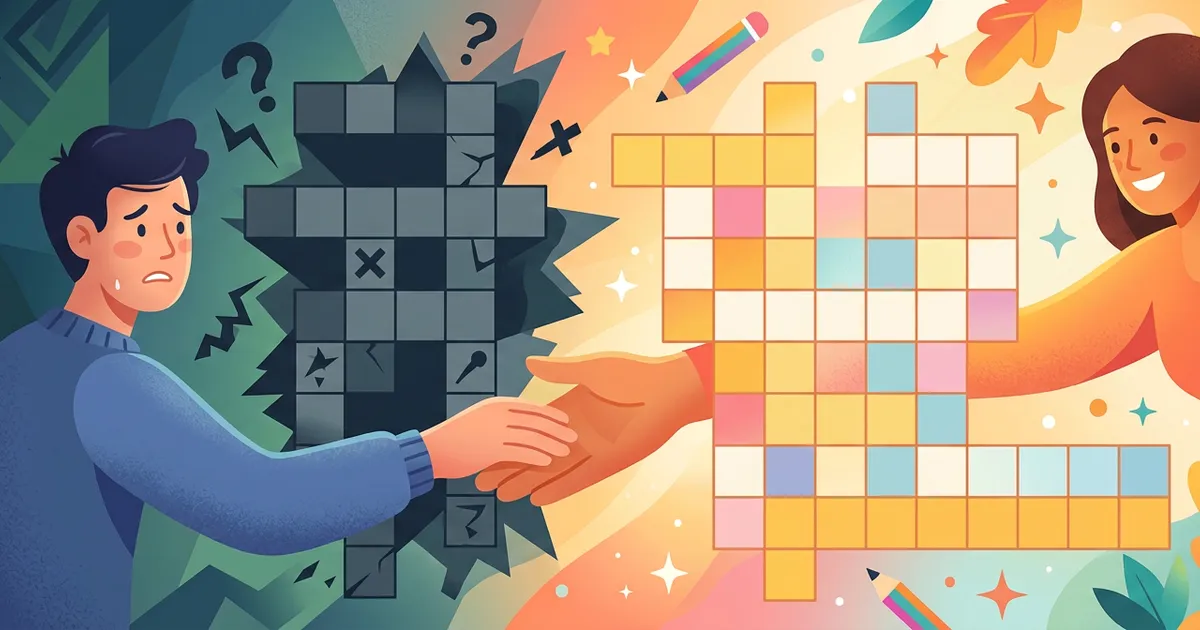
"I'm just not a crossword person."
If you've ever said this, you're not alone. A lot of people believe they're fundamentally bad at crossword puzzles. They tried one once, got stuck, felt dumb, and never tried again.
Here's the thing: you're almost certainly not bad at crosswords. You just started at the wrong difficulty. That's a fixable problem.
Why Crosswords Feel Intimidating
You started too hard
Most people's first crossword experience is a newspaper puzzle. Newspaper crosswords are Medium to Hard difficulty — they assume crossword-specific knowledge, use wordplay and misdirection, and include obscure vocabulary.
That's like trying to run a marathon on your first day of exercise. Of course it hurts. It doesn't mean you can't run — it means you started at the wrong distance.
You compared yourself to experts
Watching someone solve a crossword quickly and confidently is intimidating. But that person has solved thousands of puzzles. They know ERA, ARIA, ALOE, and EPEE from years of pattern exposure. You will too — after practice.
You hit "crosswordese" without context
Crosswords have their own vocabulary — short, letter-friendly words that appear constantly: ERNE (sea eagle), OLEO (margarine), EDDA (Norse literary work). If you've never seen these in a crossword context, they feel impossibly obscure. But after a few weeks of Easy puzzles, you'll recognize them instantly.
You thought every clue should be obvious
In a good crossword, you're not supposed to know every answer immediately. You're supposed to know some answers, use crossing letters to figure out others, and use the hint system for the rest. Getting stuck is part of the design, not a sign of failure.
The Real Reasons People Struggle (And How to Fix Each One)
Problem: "I don't know the answers"
Fix: Choose a topic you already know. A crossword about your favorite subject — movies, sports, cooking, video games — uses vocabulary you already have. You're not testing general knowledge; you're applying knowledge you already possess.
Problem: "The clues are confusing"
Fix: Start with Easy difficulty. Easy clues are direct definitions: "Capital of France" → PARIS. No wordplay, no misdirection, no tricks. You'll build to trickier clues over time.
Problem: "I get stuck and can't continue"
Fix: Use AI Hints. Grid Genius's hint system doesn't just reveal the answer — it rephrases the clue or gives a related fact to nudge you in the right direction. You still think through it yourself, but with a helpful push. More on how hints work.
Problem: "The grid is too big and overwhelming"
Fix: Start with Mini (7×7). Only 8-12 words. Completable in 5-10 minutes. It's a crossword, not an ordeal. Once Mini feels comfortable, you'll naturally want to try Standard.
Problem: "I'm too slow"
Fix: Speed doesn't matter — at all. There's no timer unless you choose to use one. Solve at whatever pace feels comfortable. A 20-minute Easy puzzle is just as valid as a 3-minute one.
Your First Crossword: A Step-by-Step Guide
Step 1: Pick a topic you love
Don't start with "General Knowledge." Start with something you're genuinely interested in:
- Love cooking? Try Food & Cooking
- Love movies? Try Hollywood
- Love animals? Try Animals
- Love sports? Try Basketball or Cricket
- Love gaming? Try Video Games
When you already know the vocabulary, you can focus on learning how crosswords work.
Step 2: Set Easy difficulty, Mini grid
This is the most accessible combination available. Common words, direct clues, small grid. If you can read English, you can complete this puzzle.
Try an Easy Mini Puzzle Right NowStep 3: Solve the easy clues first
Scan all the clues. Answer the ones you know immediately. Don't go in order — jump to whatever you can answer. Fill-in-the-blank clues ("___ of the Wild" → CALL) are usually the easiest.
Step 4: Use crossing letters
Once you've filled in a few answers, look at the words that cross them. If you have _ O _ for a 3-letter word, there aren't many options. Each letter you fill in makes the next word easier.
Step 5: Use AI Hints when stuck
Stuck on a clue? Tap the AI Hint button. It generates a contextual clue — a different angle on the same answer. Maybe the original clue didn't click, but the AI's rephrasing will. You can request multiple hints per clue, each more direct than the last.
Step 6: Finish the grid
When you fill in that last square, you've done it. You've completed a crossword puzzle. You're officially "a crossword person."
What Happens After Your First Grid
Week 1: You solve a few Easy Minis
Everything feels new. You learn some crossword patterns. You use hints freely. Each puzzle takes 8-10 minutes.
Week 2: Easy feels easier
You recognize clue patterns. "Capital of ___" is always a city name. Plural clues mean plural answers. Fill-in-the-blank is a gimme. Puzzles take 5-7 minutes.
Month 1: You try Medium
Easy is routine now. Medium introduces inference and mild wordplay. It's harder — but you have the foundation. You use hints less often.
Month 3: You have a daily habit
You solve the Grid Genius daily challenge every morning. Your streak badge shows 60+ days. You sometimes try Hard puzzles on topics you know well. Friends don't believe you when you say you used to think you were bad at crosswords.
Common "I'm Bad at This" Myths, Debunked
Myth: "You need a big vocabulary"
Reality: Easy crosswords use common English words. The specialized vocabulary (crosswordese) is a small set of maybe 50 words that you learn through exposure, not memorization. Our glossary lists the most common ones.
Myth: "You need to be good at trivia"
Reality: Grid Genius lets you choose your topic. You don't need to know random trivia — you choose puzzles about subjects you already understand.
Myth: "Smart people are naturally good at crosswords"
Reality: Crossword skill correlates with crossword practice, not IQ. A first-time solver with a PhD will struggle on a Medium crossword. A 12-year-old who's been solving daily for six months will breeze through it. Practice trumps intelligence.
Myth: "Using hints means you failed"
Reality: Grid Genius's AI Hints are a learning tool, not a crutch. They help you think through clues rather than just revealing answers. Every experienced solver started with training wheels. More on why hints aren't cheating.
Myth: "If I can't finish, I shouldn't have started"
Reality: An incomplete crossword is still a brain workout. Every clue you solve exercises your memory and language skills. You don't have to finish 100% to benefit. Progress is completing one more clue than last time.
The Grid Genius Advantage for Intimidated Solvers
Grid Genius was designed to be accessible:
- You choose the difficulty: Easy mode uses common words and direct clues
- You choose the topic: Familiar subjects mean familiar vocabulary
- You choose the size: Mini grids are small and completable in minutes
- AI Hints help you think: Contextual clues that nudge, not just reveal
- No judgment: No one sees your time, mistakes, or hint usage unless you choose to share
- Brain health benefits regardless of skill level: Even Easy puzzles exercise memory, language, and pattern recognition
One Last Thing
The people who are "naturally good" at crosswords? They weren't. They just started earlier. Every single expert solver has a story about their first crossword — and it usually involves getting stuck, feeling dumb, and needing help.
The only difference between you and them is that they tried again the next day. And the day after that. And now they solve hard puzzles for fun.
You can too. Start with one Easy Mini puzzle. See how it feels. No pressure, no timer, no judgment.
Your first crossword is waiting
Easy difficulty. Mini grid. A topic you love. AI hints when you're stuck. You've got this.
Try Your First PuzzleReady to play?
AI-generated crossword puzzles on any topic — with smart AI hints that help you think, not just give away answers. Free to play, no sign-up required.
Start Playing Free