Crossword Puzzles for Book Clubs: A Creative Discussion Activity
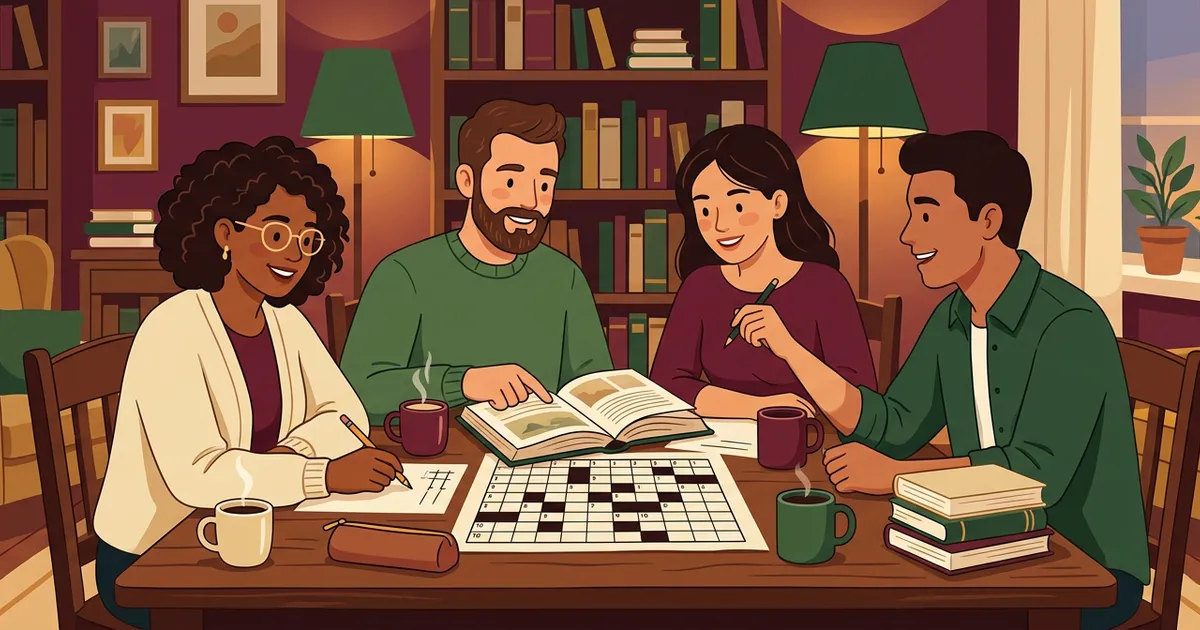
Book clubs are about more than reading — they're about discussing, debating, and connecting over shared stories. But getting the conversation started can be awkward, especially when half the group didn't finish the book.
A custom crossword puzzle about your current read is the perfect icebreaker. It tests who's been paying attention, sparks debates about details, and turns book discussion into a game.
Why Crosswords Work for Book Clubs
They break the ice
Instead of the awkward "So... what did everyone think?" opening, start with a puzzle. The crossword naturally generates conversation: "Wait, who was the character that owned the bakery?" leads to a discussion about that subplot.
They reward close reading
A crossword with clues like "The color of the door in Chapter 7" rewards members who read carefully. It's a playful way to acknowledge different levels of engagement without singling anyone out.
They're inclusive
Some book club members are quiet during open discussion. A crossword gives everyone equal footing — knowledge of the book matters more than confidence in speaking up.
They generate specific discussion points
Every clue is a potential discussion topic. "The city where the protagonist grew up" doesn't just test recall — it opens the door to "Why do you think the author chose that setting?"
How to Create a Book Club Crossword
Step 1: Gather words from the book
Pull 12-20 words from different categories:
Characters (easy entries):
- Main character names
- Antagonist names
- Important secondary characters
Settings (medium difficulty):
- Cities, countries, or fictional places
- Specific locations (a restaurant, a house, a park)
Plot elements (harder):
- Key objects (a letter, a ring, a painting)
- Important dates or time periods
- Turning point events
Themes and motifs (hardest):
- Abstract themes (redemption, identity, betrayal)
- Recurring symbols
- Literary devices used
Step 2: Write discussion-sparking clues
The clues are where the magic happens. Write them to prompt conversation, not just test recall:
| Word | Basic Clue | Discussion-Sparking Clue |
|---|---|---|
| GATSBY | Main character's last name | "The man who reinvented himself for love — was he admirable or delusional?" |
| GREEN | Color of the light across the bay | "This color represents hope, envy, and the American Dream all at once" |
| DAISY | Gatsby's love interest | "Character Tom describes as 'careless' — do you agree?" |
Step 3: Build with Grid Genius
- Open gridgenius.app/create/word-list/
- Enter your words and clues
- Choose Standard (11×11) for a 15-20 minute activity
- Generate and share the link or print copies
No account needed. Completely free.
Create your book club crossword
Enter words from your current read, generate a puzzle, share with the group.
Open Word List BuilderOr let AI do it
Enter the book title as a topic in Grid Genius — "Pride and Prejudice" or "The Great Gatsby" — and AI generates a complete crossword with characters, themes, and plot vocabulary. Quick and requires no manual word selection.
AI generation requires a Plus or Pro subscription. For club-specific details (inside jokes, specific edition page references), the free Word List Builder gives you more control.
Book Club Activity Ideas
The Pre-Meeting Puzzle
Send the crossword link a day before the meeting. Members solve on their own, then compare answers at the meeting. It ensures everyone arrives with the book fresh in mind.
The Collaborative Solve
Print one large copy and solve together at the meeting. When someone's stuck on a clue, the group discusses the answer — and the book detail behind it. This is the most discussion-generating format.
The Speed Challenge
Everyone opens the same digital link at once. First to complete wins bragging rights (or picks the next book). The competitive energy is surprisingly fun.
The "How Well Did You Read?" Quiz
Create a crossword with increasingly obscure details. Easy clues about main characters, hard clues about minor details. The group discovers who's the most attentive reader.
The Year-End Crossword
At the end of the year, create a crossword spanning all books read that year. Answers include characters, authors, titles, and themes from every book. A nostalgic celebration of the year's reading.
Genre-Specific Crossword Tips
Mystery / Thriller
Focus on red herrings, suspects, clue types, and plot twists. Clues can be deliberately misleading (just like the genre): "The person everyone suspected — but who was actually innocent."
Literary Fiction
Emphasize themes, symbolism, and character development. Use clues that invite interpretation: "The recurring motif that represents the protagonist's inner conflict."
Historical Fiction
Mix fiction and real history. "The real battle that serves as the novel's backdrop" alongside "The fictional family at the story's center."
Fantasy / Sci-Fi
World-building vocabulary is crossword gold. Fictional place names, magic systems, species names, and invented terminology create uniquely satisfying puzzles.
Non-Fiction
Key concepts, historical figures, and the author's main arguments. "The three-word phrase that summarizes the author's thesis."
Pre-Made Literature Crosswords
If you don't want to create a custom puzzle, Grid Genius offers pre-made Literature crosswords covering:
- Literary devices and terminology
- Famous authors and their works
- Poetry forms and techniques
- Classic novel vocabulary
These work as general literary knowledge puzzles — great for book clubs that want a puzzle without spoilers for the current read.
Printing for In-Person Meetings
Download any crossword as a printable image with the grid and clue lists. Print copies for each member, or print one large copy for collaborative solving. Include a separate answer key for the discussion leader.
Pro tip: Print on nice paper and bring pencils. It elevates the activity from "worksheet" to "event."
AI Hints for Solo Solvers
When members solve the digital version on their own before the meeting, Grid Genius's AI Hints help with tricky clues without just giving the answer away. The AI rephrases the clue or provides a contextual fact — nudging toward the answer while keeping the thinking (and the fun) intact. It's like having a well-read friend drop a subtle hint.
Start your book club crossword tradition
Create a puzzle about your current read in minutes. Free, no account needed.
Create a PuzzleReady to play?
AI-generated crossword puzzles on any topic — with smart AI hints that help you think, not just give away answers. Free to play, no sign-up required.
Start Playing Free