Crossword Puzzle Difficulty Levels Explained: Easy vs Medium vs Hard
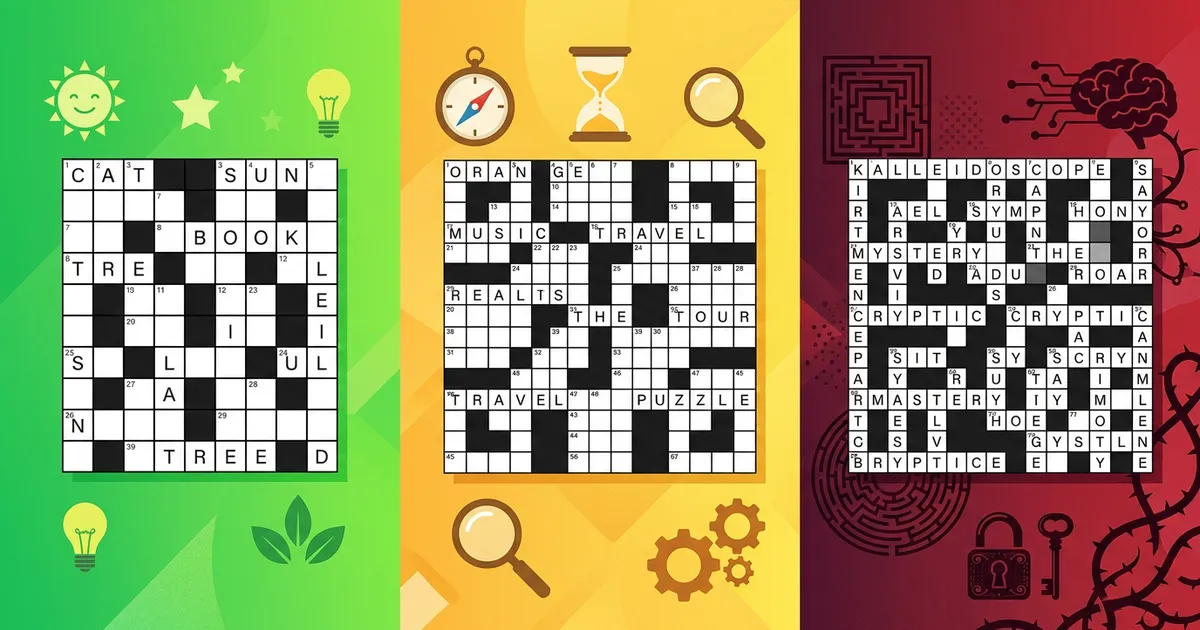
"Easy" and "Hard" mean very different things in crosswords than in most games. A hard crossword isn't just faster or more punishing — it uses fundamentally different clue-writing techniques and vocabulary. Understanding how difficulty works helps you choose the right level and improve faster.
The Three Difficulty Levels
Easy
Easy crosswords use the most straightforward clue-writing approach. Every clue leads directly to its answer with minimal ambiguity.
Clue characteristics:
- Direct definitions: "Capital of France" → PARIS
- Fill-in-the-blank: "Ready, ___, go!" → SET
- Common vocabulary only — no jargon, no obscure references
- Single-meaning clues — no wordplay or misdirection
- Short, clear phrasing
Vocabulary level:
- Everyday words most English speakers know
- No specialized terminology
- Common proper nouns (major countries, famous people)
- No "crosswordese" (obscure short words like ERNE, OLEO)
Who it's for:
- First-time crossword solvers
- Kids ages 6-10
- ESL learners building English vocabulary
- Casual solvers who want relaxation, not challenge
- Anyone returning to crosswords after a long break
Medium
Medium is where crosswords get interesting. Clues introduce variety — some are direct, some require inference, and a few use mild wordplay. This is the difficulty level most regular solvers settle into.
Clue characteristics:
- Mix of direct definitions and contextual clues
- Occasional fill-in-the-blank (but fewer than Easy)
- Some clues require inference: "It has 88 keys" → PIANO
- Mild wordplay (but always with a "?" to signal it)
- Synonym clues: "Courageous" → BRAVE
- Cross-referenced clues: "See 15-Across"
Vocabulary level:
- Moderate vocabulary including less common words
- Some topic-specific terms (accessible with crossing letters)
- A broader range of proper nouns
- Occasional crosswordese in short fill positions
Who it's for:
- Regular crossword solvers
- Adults who enjoy a moderate challenge
- Teens and advanced young solvers
- The "daily crossword" sweet spot
- Anyone who finds Easy too quick but Hard too frustrating
Hard
Hard crosswords are a different beast. Clues are deliberately deceptive, vocabulary is specialized, and the solver needs both broad knowledge and crossword-specific skills.
Clue characteristics:
- Wordplay and puns: "Current event?" → SWIM
- Misdirection: "Lead role" → STAR (not the metal)
- Multi-meaning words: "Bat" could be baseball or animal
- Cryptic-style construction in some clues
- Minimal gimmes — few fill-in-the-blank or obvious definition clues
- Abbreviated clues for abbreviated answers (without always saying "abbr.")
Vocabulary level:
- Specialized and domain-specific terms
- Obscure but real words
- Deep proper nouns (specific historical figures, places, works)
- Full crosswordese: ERNE, EPEE, OLEO, ARIA, etc.
- Technical vocabulary from the chosen topic
Who it's for:
- Experienced crossword enthusiasts
- Solvers who've mastered Medium and want more
- People with broad general knowledge
- The "NYT Saturday" crowd
- Anyone who enjoys being genuinely stumped (and working through it)
How Difficulty Works Differently in Grid Genius vs NYT
Grid Genius: You choose
Grid Genius lets you select difficulty independently from grid size. Want a Large Easy puzzle? Done. A Mini Hard? Also available. This creates 9 combinations, each with a distinct experience.
The difficulty controls clue style and vocabulary while the size controls word count and grid dimensions. They're separate axes.
NYT: Day-of-week progression
The NYT ties difficulty to the day of the week:
- Monday: Easiest — direct clues, common vocabulary
- Tuesday: Slightly harder — some inference required
- Wednesday: Moderate — themed puzzles, broader vocabulary
- Thursday: Tricky — often includes gimmicks (rebuses, unusual grid features)
- Friday: Very hard — misdirection, obscure vocabulary, no theme
- Saturday: Hardest — maximum misdirection, minimum gimmes
You can't choose "I want a Hard NYT puzzle today" — you get whatever the day demands. Grid Genius gives you the control.
Same Word, Three Different Clues
Here's how difficulty changes the clue for the same answer:
| Answer | Easy Clue | Medium Clue | Hard Clue |
|---|---|---|---|
| MARS | The red planet | Fourth from the sun | Home to Olympus Mons |
| PIANO | Musical instrument with keys | It has 88 keys | Steinway product |
| OPERA | Musical performance with singing | La Scala offering | Where you'd hear an aria |
| CELL | Unit of a battery | Monk's quarters | It can be solar or prison |
| BARK | Sound a dog makes | Tree's outer layer | It could be worse than a bite? |
Notice how Easy clues are unambiguous, Medium clues require knowledge or inference, and Hard clues use misdirection or obscure references.
The Role of AI Hints Across Difficulty Levels
Grid Genius's AI Hints are especially valuable as you push into higher difficulty levels:
On Easy: You probably won't need hints often. When you do, the AI confirms your thinking.
On Medium: AI Hints help when a clue uses an unfamiliar angle. The hint rephrases the clue in a way that might click. "Oh, they meant that kind of key!"
On Hard: AI Hints are essential for learning. When a clue uses misdirection you've never seen before, the AI hint teaches you the pattern without just giving the answer. Over time, you start recognizing the wordplay techniques and need hints less.
The key difference from traditional hints: AI Hints help you think, not just reveal. That's why they're a learning tool, not a crutch.
How to Progress Through Difficulty Levels
Step 1: Master Easy Mini
Complete Easy Mini puzzles consistently without hints. This builds basic crossword mechanics: reading clues, filling cells, using crossing letters.
Step 2: Move to Easy Standard
The bigger grid introduces more words and more crossing opportunities. Still straightforward clues, but more of them.
Step 3: Jump to Medium Mini
This is where clue-writing style changes. The smaller grid keeps the word count manageable while you adapt to inference-based clues.
Step 4: Medium Standard
The daily-driver difficulty. Most regular solvers live here. You'll build the crossword vocabulary and pattern recognition that makes this level comfortable.
Step 5: Try Medium Large or Hard Mini
Increase one dimension at a time. Medium Large gives you more words at familiar difficulty. Hard Mini gives you tricky clues in a compact format.
Step 6: Hard Standard and beyond
You're an experienced solver now. Hard Standard puzzles require broad knowledge, pattern recognition, and comfort with wordplay. Hard Large is the ultimate challenge.
The key principle: Increase size or difficulty, not both at once. Jumping from Easy Mini to Hard Large is a recipe for frustration.
Difficulty and Topic Interaction
Your familiarity with the topic dramatically affects perceived difficulty:
- A sports fan solving a Sports crossword on Hard might find it easier than a general Hard puzzle
- A science student can handle Chemistry on Hard but might struggle with Pop Culture on Medium
- Choosing a familiar topic effectively lowers difficulty by one level
This is why Grid Genius's topic selection is powerful: you can solve Hard puzzles on your strongest subject while building skills to tackle Hard on unfamiliar topics.
Find your difficulty level
Easy for beginners, Medium for daily solvers, Hard for experts. Choose any topic.
Start PlayingReady to play?
AI-generated crossword puzzles on any topic — with smart AI hints that help you think, not just give away answers. Free to play, no sign-up required.
Start Playing Free