10 Brain Exercises You Can Do in 5 Minutes a Day
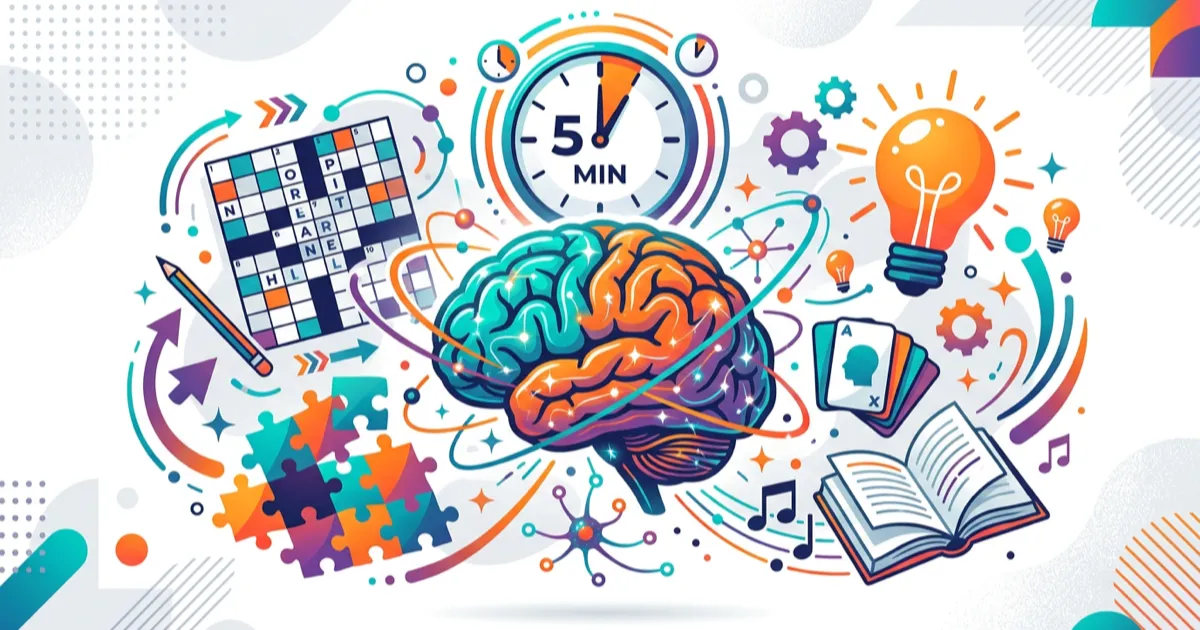
You don't need an hour at the gym for your brain. Five minutes of targeted mental exercise — done consistently — can meaningfully improve memory, focus, and cognitive function.
Here are 10 research-backed brain exercises ranked by effectiveness, all completable in 5 minutes or less.
1. Mini Crossword Puzzle
Time: 3-5 minutes | Exercises: Vocabulary, memory retrieval, pattern recognition, language processing
The single most effective 5-minute brain exercise. Research from Duke and Columbia found crossword puzzles outperformed computer-based brain training games at improving memory and cognitive function.
A mini crossword (7×7 grid) engages multiple brain systems simultaneously: you retrieve words from semantic memory, parse clue meanings, recognize letter patterns, and hold multiple partial answers in working memory. No other 5-minute activity exercises this many cognitive functions at once.
Grid Genius offers a free daily challenge plus AI-generated puzzles on any topic — with AI hints that help you think deeper rather than just revealing answers.
Play a Free Mini Crossword2. Mental Math
Time: 2-3 minutes | Exercises: Working memory, processing speed, numerical reasoning
Skip the calculator for simple arithmetic. Add up your grocery bill mentally. Calculate tips in your head. Multiply two-digit numbers.
Quick drill: Start at 100, subtract 7 repeatedly (100, 93, 86, 79...). This serial subtraction test is actually used clinically to assess cognitive function.
3. Word Recall
Time: 3 minutes | Exercises: Short-term memory, memory encoding
Read a list of 15 random words. Close your eyes and try to recall as many as possible. Most people remember 7±2 on the first try. Practice regularly and the number improves.
Variation: Try to recall the words in the exact order they appeared (serial recall — much harder).
4. Vocabulary Building
Time: 3-5 minutes | Exercises: Semantic memory, language processing
Learn one new word each day. Read the definition, use it in a sentence, and try to use it in conversation. Over a year, that's 365 new words.
Crossword connection: Solving crosswords naturally builds vocabulary. Each puzzle teaches 2-3 new words through contextual clues.
5. Observation and Detail Recall
Time: 2 minutes | Exercises: Visual memory, attention to detail
Look at a complex image (a photograph, a painting, a busy scene) for 30 seconds. Close your eyes and describe as many details as you can. Colors, positions, objects, people, text.
This exercises the visual memory system — different from the verbal memory exercised by crosswords.
6. Name-Face Association
Time: 3 minutes | Exercises: Associative memory, facial recognition
When meeting new people, create a mental association between their name and a visual feature. "Sandy has sandy-colored hair." "Mark has a mark (freckle) on his cheek."
Practice: Go through photos of people you've met recently and try to recall their names.
7. Pattern Recognition Games
Time: 3-5 minutes | Exercises: Spatial reasoning, logical thinking
Sudoku, pattern matching, and sequence completion exercises train different cognitive systems than word-based puzzles. A mini Sudoku takes 3-5 minutes and exercises logical reasoning and spatial pattern recognition.
Best combination: Alternate between crosswords (verbal) and Sudoku (spatial) for the broadest cognitive workout.
8. Mindful Breathing with Counting
Time: 3 minutes | Exercises: Attention, focus, working memory
Breathe in for 4 counts, hold for 4, out for 4, hold for 4. Count each cycle. If you lose count, start over. This sounds simple but demands sustained attention — and it doubles as stress reduction.
9. Reverse Spelling
Time: 2-3 minutes | Exercises: Working memory, phonological processing
Spell words backwards in your head. Start with short words (CAT → T-A-C) and work up to longer ones (ELEPHANT → T-N-A-H-P-E-L-E). This forces your working memory to hold and manipulate sequences.
10. New Route Navigation
Time: 5 minutes | Exercises: Spatial memory, hippocampal function
Take a different route to a familiar destination. Or navigate without GPS to a place you've been before. Spatial navigation is one of the strongest activators of the hippocampus — the brain region most affected by cognitive aging.
The Optimal Daily Brain Routine
If you only have 5 minutes, do a mini crossword. It exercises the most cognitive functions in the least time.
If you have 10-15 minutes, combine two or three exercises from different categories:
| Time | Exercise | Category |
|---|---|---|
| 5 min | Mini crossword | Verbal + memory |
| 3 min | Mental math | Numerical + working memory |
| 2 min | Observation recall | Visual memory |
The key principle: variety across cognitive domains. Don't do the same exercise every day. Alternate between verbal (crosswords, word recall), numerical (mental math), spatial (Sudoku, navigation), and attentional (mindful breathing) exercises.
Consistency Over Intensity
The single most important factor is daily consistency. A 5-minute daily exercise provides more cumulative benefit than a 60-minute weekend session because:
- Neural pathways strengthen through repeated activation, not intensity
- Habit formation requires daily repetition (average 66 days to form)
- Memory consolidation happens best with spaced, regular practice
Grid Genius's daily crossword challenge is designed for exactly this: a new puzzle every day, streak tracking with milestone badges, and a global leaderboard to keep you motivated.
Start your 5-minute brain exercise habit
A free daily crossword puzzle. Takes 5 minutes. Builds streaks. No account needed.
Play Today's PuzzleReady to play?
AI-generated crossword puzzles on any topic — with smart AI hints that help you think, not just give away answers. Free to play, no sign-up required.
Start Playing Free