The 10 Best Science Crossword Topics for Curious Minds
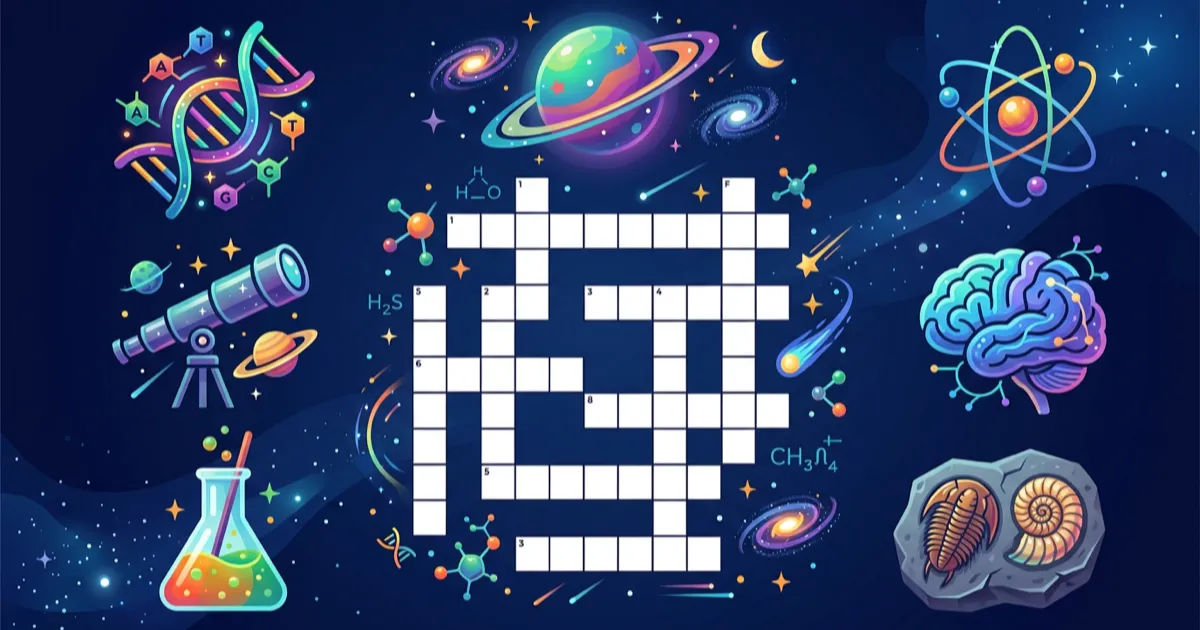
Science and crossword puzzles make a surprisingly great pair. The vocabulary is rich, the concepts connect in unexpected ways, and there's always something new to learn while solving.
Whether you're a biology buff or a space nerd, here are the best science topics to turn into crossword puzzles.
1. Space Exploration
From Apollo missions to Mars rovers, space exploration is packed with crossword-worthy vocabulary. Think "nebula," "perihelion," "telemetry," and "apogee." The mix of technical terms and household names (NASA, Hubble, SpaceX) makes for puzzles that are both challenging and accessible. You can draw clues from rocket engineering ("thrust," "propellant"), planetary science ("exoplanet," "magnetosphere"), and mission history ("Sputnik," "Voyager"). It is one of the most versatile science topics because it spans physics, engineering, and even biology when you consider topics like astronaut health.
Try a Space Exploration Puzzle2. Human Anatomy
Bones, muscles, organs — the human body is essentially a crossword dictionary. Medical terminology has Latin and Greek roots that create satisfying letter patterns. "Phalanges" crossing "esophagus" just works. You can build puzzles around specific systems like the skeletal system ("femur," "clavicle," "sternum"), the circulatory system ("aorta," "ventricle," "capillary"), or the nervous system ("synapse," "neuron," "cortex"). Anatomy puzzles are especially popular with nursing and pre-med students who need to memorize hundreds of terms.
Try a Human Anatomy Puzzle3. Chemistry Elements
The periodic table alone gives you 118 potential answers, each with properties, discoverers, and etymology to draw clues from. Can you tell your "argon" from your "xenon"? Beyond element names, chemistry offers rich vocabulary from bonding ("covalent," "ionic"), reactions ("oxidation," "catalyst," "reagent"), and lab equipment ("beaker," "pipette," "crucible"). Clue writers can reference atomic numbers, element symbols, or the scientists who discovered them — giving every puzzle multiple difficulty levels from the same word list.
Try a Chemistry Elements Puzzle4. Marine Biology
Coral reefs, deep-sea creatures, and ocean ecosystems provide vivid vocabulary. Words like "bioluminescence," "plankton," and "thermocline" add variety to any puzzle grid. Marine biology also covers fascinating niches like cetacean behavior ("echolocation," "pod," "baleen"), tidal ecology ("intertidal," "estuary"), and deep-sea exploration ("bathymetry," "hydrothermal vent"). The sheer diversity of marine life — from microscopic diatoms to blue whales — means you can create dozens of unique puzzles without repeating a single word.
Try a Marine Biology Puzzle5. Genetics & DNA
The language of genetics — codons, phenotypes, CRISPR, alleles — is precise and crossword-friendly. Plus, recent breakthroughs mean the vocabulary keeps growing. You can build puzzles around classical genetics ("Mendel," "dominant," "recessive," "Punnett"), molecular biology ("ribosome," "transcription," "polymerase"), or cutting-edge topics like gene therapy and genomic sequencing. The field's rapid evolution means there is always fresh material for new puzzles.
Try a Genetics & DNA Puzzle6. Dinosaurs & Paleontology
Long species names might seem tricky, but they break down beautifully in grids. "Velociraptor" is 12 letters of crossword gold. Mix in geological eras ("Jurassic," "Cretaceous," "Triassic"), fossil types ("ammonite," "coprolite"), and excavation vocabulary ("stratum," "sediment," "excavation") for a well-rounded puzzle. Paleontology also lets you write fun, visual clues — "Three-horned herbivore" for TRICERATOPS is the kind of entry that makes solvers smile.
Try a Dinosaurs Puzzle7. Weather & Meteorology
Everyone talks about the weather, but few know words like "mesocyclone" or "derecho." Weather puzzles bridge common knowledge with satisfying technical terms. You can include instrument names ("barometer," "anemometer"), cloud types ("cumulonimbus," "cirrus," "stratus"), and phenomena ("El Nino," "jet stream," "front"). Because everyone has a basic understanding of weather, these puzzles are great for mixed-ability groups — casual solvers recognize "tornado" while experts tackle "isobar."
Try a Weather Puzzle8. Astronomy & Constellations
Star names, constellation patterns, and celestial mechanics provide a beautiful vocabulary set. From "Betelgeuse" to "ecliptic," the words are as fascinating as the night sky. Constellation names ("Orion," "Cassiopeia," "Ursa Major"), stellar classifications ("red dwarf," "pulsar," "quasar"), and observational tools ("telescope," "spectrometer") all work well in grids. Astronomy puzzles pair nicely with mythology clues since many star and constellation names have Greek and Roman origins.
Try an Astronomy Puzzle9. Ecology & Environment
Climate science, ecosystems, biodiversity — these topics are timely and rich with interconnected vocabulary. "Symbiosis," "trophic," and "watershed" make excellent crossword entries. You can also draw from conservation ("endangered," "habitat," "reforestation"), energy ("renewable," "photovoltaic," "biomass"), and environmental science ("ozone," "carbon footprint," "emission"). Because ecology is in the news daily, solvers often encounter these terms outside the puzzle, reinforcing retention.
Try an Ecology Puzzle10. Quantum Physics
For the advanced solver: quantum mechanics vocabulary is uniquely challenging. "Superposition," "entanglement," and "fermion" will test even the most knowledgeable puzzlers. Add in historical figures ("Planck," "Heisenberg," "Schrodinger"), key concepts ("uncertainty," "wave function," "duality"), and particle physics terms ("boson," "lepton," "hadron") for a puzzle that truly separates the experts from the amateurs. These puzzles make great gifts for the physicist in your life.
Try a Quantum Physics PuzzleExplore all science puzzles
Browse our collection of AI-generated science crosswords — from chemistry to quantum physics.
Browse Science PuzzlesWhy Science Topics Work So Well for Crosswords
Science vocabulary has a few properties that make it ideal for crossword construction:
- Precise definitions make for unambiguous clues
- Latin/Greek roots create predictable letter patterns
- Cross-domain connections allow creative clue-writing
- Graduated difficulty — basic terms for easy puzzles, specialized jargon for hard ones
The best part? You learn while you play. Every puzzle reinforces vocabulary and connections between concepts. It's education disguised as entertainment.
Sample Science Crossword Clues
Here are example clue-and-answer pairs across different science topics to show the range of difficulty:
| Clue | Answer | Topic |
|---|---|---|
| Gas that makes up 78% of Earth's atmosphere | NITROGEN | Chemistry |
| Smallest bone in the human body | STAPES | Anatomy |
| Term for an animal that eats both plants and meat | OMNIVORE | Ecology |
| Speed of light is approximately 300,000 km per ___ | SECOND | Physics |
| Double-helix molecule that carries genetic code | DNA | Genetics |
| Deepest point in the ocean, located in the Mariana Trench | CHALLENGER | Marine Biology |
These clues illustrate why science works so well in crosswords: each answer is factual, unambiguous, and learnable. A solver who doesn't know the answer today will remember it next time.
Tips for Solving Science Crosswords
- Start with the roots. Many science terms share Latin or Greek roots. If you know that "osteo" means bone and "cyte" means cell, you can piece together "osteocyte" even without memorizing it beforehand.
- Use crossing letters. Science crosswords often have one or two obscure terms balanced by common ones. Solve the easier entries first, then use the crossing letters to narrow down the technical vocabulary.
- Think about word length. If a clue says "type of chemical bond" and you have five spaces, "ionic" fits but "covalent" does not. Matching letter count eliminates wrong guesses quickly.
- Don't overthink it. Many science clues use straightforward definitions rather than wordplay. "The study of earthquakes" is simply SEISMOLOGY — no trick involved.
Create Your Own Science Crossword
Teachers, tutors, and science communicators can build custom science crosswords in minutes. The free Word List Builder lets you enter your own vocabulary terms and clues, then generates a printable crossword grid automatically. It is ideal for vocabulary quizzes, review sessions, or science fair activities.
If you prefer to let AI do the work, Grid Genius can generate a crossword on any topic — just type "Organic Chemistry" or "Volcanoes" and a complete puzzle appears in seconds. The AI selects age-appropriate vocabulary and writes original clues.
Looking for more topic ideas? Browse our full guide to crossword puzzle topics or see how teachers are using crossword puzzles in the classroom.
Ready to play?
AI-generated crossword puzzles on any topic — with smart AI hints that help you think, not just give away answers. Free to play, no sign-up required.
Start Playing Free