The 10 Best History Crossword Topics for History Buffs
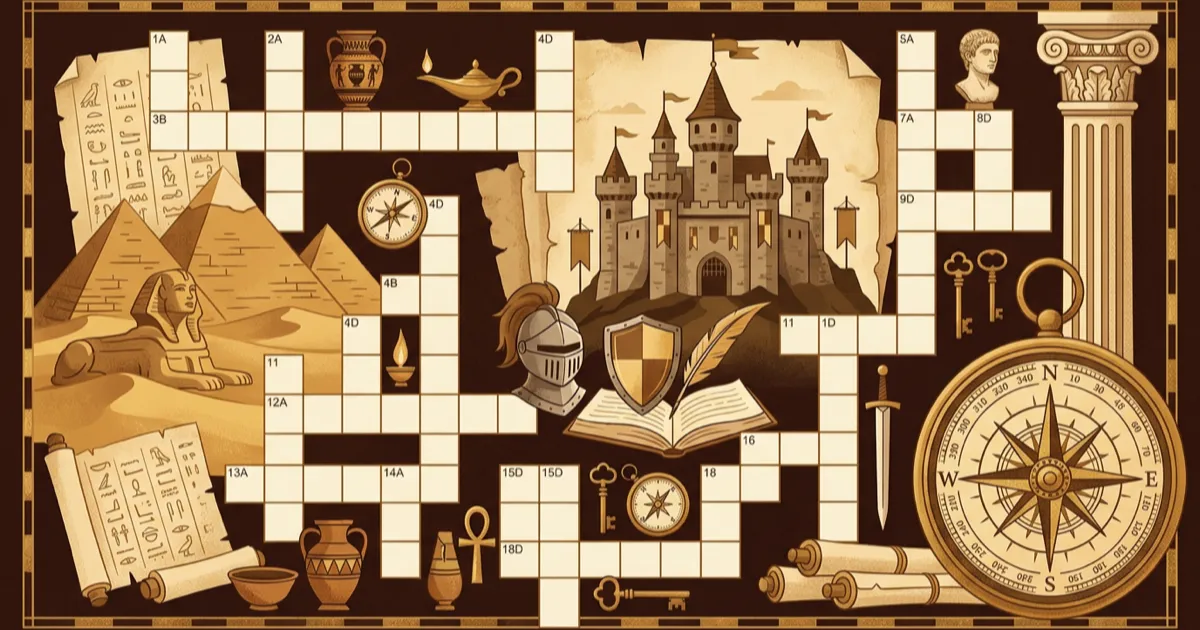
History and crosswords are a natural match. Historical vocabulary is precise, names are memorable, and the stories behind the clues make solving feel like learning. Whether you're a casual history fan or a serious student, these topics produce the best crossword puzzles.
1. Ancient Egypt
Pharaohs, pyramids, hieroglyphics, and the Nile Delta — Ancient Egypt offers crossword-perfect vocabulary. Words like "sarcophagus," "Tutankhamun," and "Cleopatra" create dramatic entries, while shorter terms like "Nile," "Isis," and "Ra" fill gaps beautifully. The civilization's 3,000-year timeline provides vocabulary from every era: Old Kingdom terms like "mastaba" and "vizier," New Kingdom references like "Ramesses" and "Karnak," and Ptolemaic-era words like "Rosetta" and "Alexandria." Even everyday Egyptian life contributes crossword-worthy vocabulary — "papyrus," "scarab," "obelisk," and "ankh" are short, letter-friendly words that constructors love.
Try an Ancient Civilizations Puzzle2. World War II
The most documented conflict in history produces an enormous vocabulary: battles (Normandy, Stalingrad), leaders (Churchill, Roosevelt, Eisenhower), technology (radar, enigma), and geography (Midway, Dunkirk). WWII crosswords balance familiar names with less-known details. The war's global scale means vocabulary spans every continent — Pacific theater terms like "Iwo Jima" and "kamikaze," European campaign words like "Blitzkrieg" and "Panzer," and home front vocabulary like "rationing," "propaganda," and "Rosie." Code-breaking terminology (Enigma, Ultra, Bletchley) and military ranks (admiral, brigadier, sergeant) add further depth for harder puzzles.
Try a History Puzzle3. Ancient Rome
From senators to gladiators, the Roman Empire's vocabulary is woven into modern English. "Forum," "aqueduct," "centurion," "colosseum" — these words are both historically significant and crossword-friendly. Latin roots make letter patterns predictable. Roman government terms like "consul," "tribune," "senate," and "republic" have direct modern parallels, while military vocabulary such as "legion," "cohort," "gladius," and "trireme" evokes the empire's martial culture. Famous figures — Julius Caesar, Augustus, Nero, Marcus Aurelius — are crossword staples, and Roman engineering feats provide words like "viaduct," "amphitheater," and "basilica" that work at any grid size.
Try a Hard Ancient Civilizations Puzzle4. The American Revolution
The birth of the United States offers a compact vocabulary set: Founding Fathers (Jefferson, Hamilton, Franklin), key events (Boston Tea Party, Valley Forge), and concepts (independence, constitution, democracy). Well-known enough for easy puzzles, deep enough for hard ones. Deeper vocabulary includes military terms like "minuteman," "musket," and "Continental Army," place names like "Lexington," "Concord," and "Yorktown," and political concepts like "taxation," "sovereignty," and "federalism." The era also produced iconic documents — the Declaration of Independence, the Bill of Rights, the Federalist Papers — whose language offers rich clue material for advanced solvers.
5. Medieval History
Knights, castles, the Crusades, the Black Plague, Magna Carta — the medieval period has dramatic vocabulary that creates vivid crossword clues. "Feudalism," "trebuchet," and "excommunication" are satisfying long entries. The medieval world also provides terms from daily life — "serf," "guild," "tithe," "moat," and "keep" — that work as compact grid fillers. Religious vocabulary like "monastery," "pilgrimage," "inquisition," and "heresy" adds cultural depth, while chivalric terms such as "jousting," "herald," "squire," and "courtly love" bring the era's romantic side into puzzles.
6. Ancient Greece
The birthplace of democracy, philosophy, and the Olympics. Names like Socrates, Plato, and Aristotle are crossword staples. Add mythology (Zeus, Athena, Odysseus) and you have an inexhaustible supply of clue material. Greek city-states contribute location-based vocabulary — "Sparta," "Athens," "Corinth," "Delphi" — while the arts provide "tragedy," "comedy," "chorus," and "amphora." Scientific and mathematical terms with Greek origins, such as "theorem," "geometry," "hypothesis," and "atom," extend these puzzles into interdisciplinary territory that rewards broadly curious solvers.
Try a Mythology Puzzle7. The Cold War
Espionage, space race, nuclear standoffs, and geopolitics. Cold War vocabulary spans technology (Sputnik, ICBM), people (Kennedy, Khrushchev), and concepts (detente, containment, Iron Curtain). The clue-writing possibilities are rich. Spy terminology adds a thriller element — "mole," "defector," "cipher," "surveillance," and "double agent" — while the nuclear arms race contributes "fallout," "warhead," "proliferation," and "MAD" (mutually assured destruction). The space race vocabulary alone, from "cosmonaut" to "Apollo" to "orbit," could fill multiple puzzles.
8. The Renaissance
Art, science, and cultural rebirth. Da Vinci, Michelangelo, Gutenberg, Machiavelli — the Renaissance gave us both famous names and concepts (humanism, perspective, patronage) that make excellent crossword entries. The era's artistic achievements provide terms like "fresco," "chiaroscuro," "sfumato," and "Sistine," while the scientific revolution introduces "heliocentric," "anatomy," "Copernicus," and "Galileo." The printing press alone spawned vocabulary — "movable type," "folio," "manuscript," "illumination" — that connects medieval scholarship to the modern world.
9. Exploration and Discovery
From Columbus to Magellan, the Age of Exploration is packed with geography, navigation terms, and cultural encounters. "Caravel," "astrolabe," "circumnavigation," and "New World" create satisfying vocabulary sets. Explorer names like "Drake," "Cortez," "Pizarro," and "Vasco da Gama" serve as proper-noun anchors, while navigation terms — "sextant," "longitude," "cartography," "trade winds" — provide technical depth. The cultural impact of exploration introduces words like "colonization," "spice route," "Silk Road," and "mercantilism" that connect commerce, geography, and politics.
Try a Geography Puzzle10. Modern Revolutions
The French Revolution, Russian Revolution, Industrial Revolution — each brings its own vocabulary. "Guillotine," "Bolshevik," "proletariat," "suffrage," and "abolition" are powerful crossword words with rich clue potential. The French Revolution alone provides "Bastille," "Jacobin," "Robespierre," "Reign of Terror," and "Napoleon," while the Industrial Revolution introduces "factory," "steam engine," "locomotive," "urbanization," and "labor union." These overlapping revolutionary periods make it possible to create thematic puzzles that trace how one upheaval inspired the next.
Explore all history puzzles
AI-generated crosswords on any historical topic — from Ancient Egypt to the Cold War.
Browse History PuzzlesWhy History Topics Work for Crosswords
- Proper nouns provide anchors: Historical names are unambiguous clue targets
- Cross-era connections: A puzzle can link ancient and modern concepts through shared themes
- Graduated difficulty: Familiar events for easy puzzles, obscure details for hard ones
- Educational value: Every puzzle teaches something about the past
- Precise dates and places: Create fact-based clues with clear right answers
Teachers can also use these topics to create custom classroom crosswords with the free crossword puzzle maker for teachers.
Sample History Crossword Clues
Here are example clue-and-answer pairs you might find in a history crossword:
| Clue | Answer |
|---|---|
| Egyptian sun god | RA |
| D-Day beach in Normandy | OMAHA |
| Roman gathering place | FORUM |
| Author of "The Prince" | MACHIAVELLI |
| Cold War divider through Berlin | WALL |
| Navigation tool used by explorers | ASTROLABE |
These entries show why history works so well for crosswords — the answers range from short grid fillers (RA, WALL) to satisfying long entries (MACHIAVELLI, ASTROLABE), and every clue teaches a historical fact.
Tips for Solving History Crosswords
1. Start with the proper nouns. Historical names like "Churchill" or "Cleopatra" have fixed spellings that give you reliable anchor letters. Fill these in first to reveal crossing letter patterns.
2. Use era context to narrow answers. If the puzzle theme is Ancient Rome, a clue like "military unit" almost certainly means LEGION or COHORT, not "platoon" or "battalion." Let the historical context guide your guesses.
3. Look for Latin and Greek roots. Many history terms derive from classical languages. Recognizing roots like "aqua-" (water), "bellum" (war), or "demos" (people) can help you decode unfamiliar vocabulary.
4. Use AI hints when stuck. If a clue has you stumped, Grid Genius offers AI-powered hints that reveal a letter or nudge you toward the answer without giving it away entirely — perfect for learning while you solve.
Related Reading
- The Complete Guide to 50+ Crossword Puzzle Topics — browse every category from science to sports
- How to Make Crossword Puzzles for Your Classroom — create custom history puzzles for students
Ready to play?
AI-generated crossword puzzles on any topic — with smart AI hints that help you think, not just give away answers. Free to play, no sign-up required.
Start Playing Free