Best Brain Games for Commuters: Make Your Ride Productive
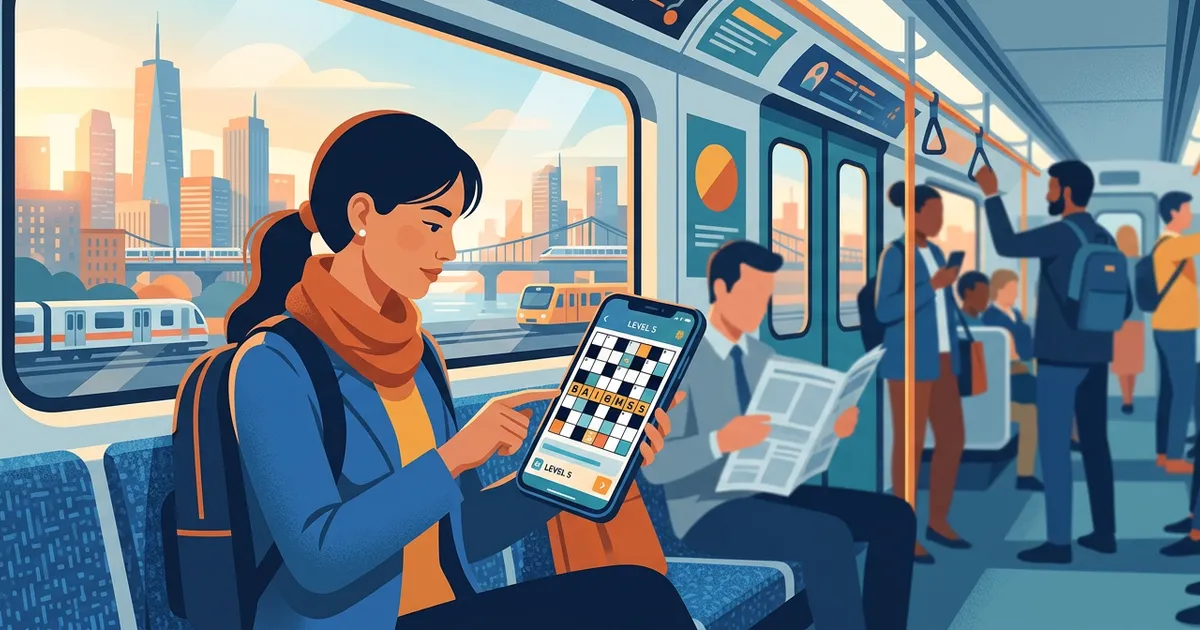
The average American commutes 27 minutes each way. That's nearly an hour a day, five days a week — 250+ hours a year spent in transit. Most people fill that time scrolling social media or staring at nothing.
What if you used even half of it for brain training instead?
Here are the best brain games that fit into a commute, ranked by time required and cognitive benefit.
The Best Commute Brain Games
1. Mini Crossword Puzzle (3-10 minutes)
The ideal commute brain game. A Mini crossword (7×7 grid) takes 3-10 minutes depending on difficulty — perfect for a subway ride or bus trip.
Why it's great for commuting:
- Fits any commute length (pause and resume if needed)
- Engages multiple cognitive systems: vocabulary, pattern recognition, language processing
- Research-backed brain benefits — more effective than brain training apps
- Works offline if you print beforehand
- Choose from 50+ topics so it never gets repetitive
- AI Hints help when you're stuck — contextual clues that make you think, not just reveal answers
Time required: 3-10 minutes (Mini), 10-25 minutes (Standard)
Play a Mini Crossword2. Wordle (2-5 minutes)
The ultra-quick option. Guess a 5-letter word in 6 tries. Takes 2-5 minutes max and exercises letter-pattern logic and elimination reasoning.
Why it's great for commuting: One puzzle per day, guaranteed done before your stop.
Limitation: Only exercises letter logic — narrower cognitive benefit than crosswords. See our detailed comparison.
Time required: 2-5 minutes
3. Sudoku (5-20 minutes)
Number placement puzzles that exercise spatial reasoning and logical deduction — different brain regions than word games.
Why it's great for commuting: No language needed (great for noisy environments), scales well from easy (5 min) to expert (20+ min).
Time required: 5-20 minutes
4. NYT Connections (3-8 minutes)
Group 16 words into 4 categories. Tests categorization, lateral thinking, and vocabulary breadth.
Why it's great for commuting: Quick, satisfying, and feels like a mini puzzle rush.
Time required: 3-8 minutes
5. Spelling Bee (10-30 minutes)
Make words from 7 letters (one required). Open-ended — no single "done" point, so you solve as long as your commute lasts.
Why it's great for commuting: No fixed end time means it adapts to any commute length. Deep vocabulary exercise.
Time required: 10-30 minutes (flexible)
6. Reading (Any length)
Not a "game," but reading exercises comprehension, vocabulary, and imagination. E-books and audiobooks make it commute-friendly.
Time required: Any length
Comparison Table
| Game | Time | Cognitive Benefit | Offline | Noise-Friendly | Daily Limit |
|---|---|---|---|---|---|
| Mini Crossword | 3-10 min | High (multi-system) | Print option | Yes | Unlimited |
| Wordle | 2-5 min | Moderate (logic) | No | Yes | 1/day |
| Sudoku | 5-20 min | Moderate (spatial) | Yes (apps) | Very | Unlimited |
| Connections | 3-8 min | Moderate (categorization) | No | Yes | 1/day |
| Spelling Bee | 10-30 min | Moderate (vocabulary) | No | Yes | 1/day |
Build a Commute Brain Training Routine
Short commute (under 10 minutes)
Morning: Mini crossword (Easy) — wake up your brain with familiar vocabulary Evening: Wordle — quick wind-down puzzle
Medium commute (10-20 minutes)
Morning: Standard crossword (Medium) — deeper engagement Evening: Mini crossword on a fun topic (Pop Culture, Sports)
Long commute (20-40 minutes)
Morning: Standard crossword (Hard) — full cognitive workout Evening: Mix of Sudoku + Mini crossword, or a Large crossword
Train/subway tips
- Download or print puzzles beforehand for underground sections with no signal
- Use headphones to block noise — puzzles require focus
- Keep a pencil in your bag for printed crosswords (pens are unforgiving)
Bus/car passenger tips
- Phone puzzles work better than paper in a moving vehicle
- Grid Genius's AI Hints help when bumpy rides break your concentration
- Choose Easy difficulty if motion affects your focus
Why Crosswords Beat Social Media for Your Commute
| Crossword Puzzle | Social Media Scrolling | |
|---|---|---|
| Cognitive effect | Builds vocabulary, memory, pattern recognition | Reduces attention span, increases anxiety |
| Mood after | Satisfied, mentally stimulated | Often worse (comparison, outrage, FOMO) |
| Cumulative effect | 250+ hours/year of brain training | 250+ hours/year of passive consumption |
| Research support | Duke/Columbia study: improves memory | Multiple studies: associated with reduced well-being |
| Streak motivation | Grid Genius tracks streaks with badges | Algorithm tracks engagement for ads |
The comparison isn't close. Replacing even 15 minutes of daily scrolling with a crossword puzzle is one of the easiest cognitive health improvements you can make.
Print a Commute Puzzle Pack
Don't rely on cell signal. Before the week starts, print 5 crosswords (one per day) on different topics:
- Go to play.gridgenius.app
- Browse topics and pick 5 puzzles you'll enjoy
- Download and print each one
- Fold them into your bag with a pencil
- Solve one per commute day
See our printable crossword guide for more details.
The Daily Crossword Commute Habit
The most effective brain exercise is the one you do consistently. Grid Genius's daily challenge is designed for exactly this:
- New puzzle every day at midnight UTC
- Streak tracking with milestone badges (7, 14, 30, 60, 90, 365 days)
- Global leaderboard — compete with other commuters worldwide
- Takes 10-15 minutes — fits most commutes
- Free, no account needed
Anchor it to your commute and it becomes automatic: get on the train → open Grid Genius → solve. Within a month, you won't even think about reaching for social media.
Transform your commute
A free daily crossword that takes 10 minutes. Track your streak. Beat your time.
Play Today's PuzzleReady to play?
AI-generated crossword puzzles on any topic — with smart AI hints that help you think, not just give away answers. Free to play, no sign-up required.
Start Playing Free