What Makes a Good Crossword Clue? The Art of Clue Writing
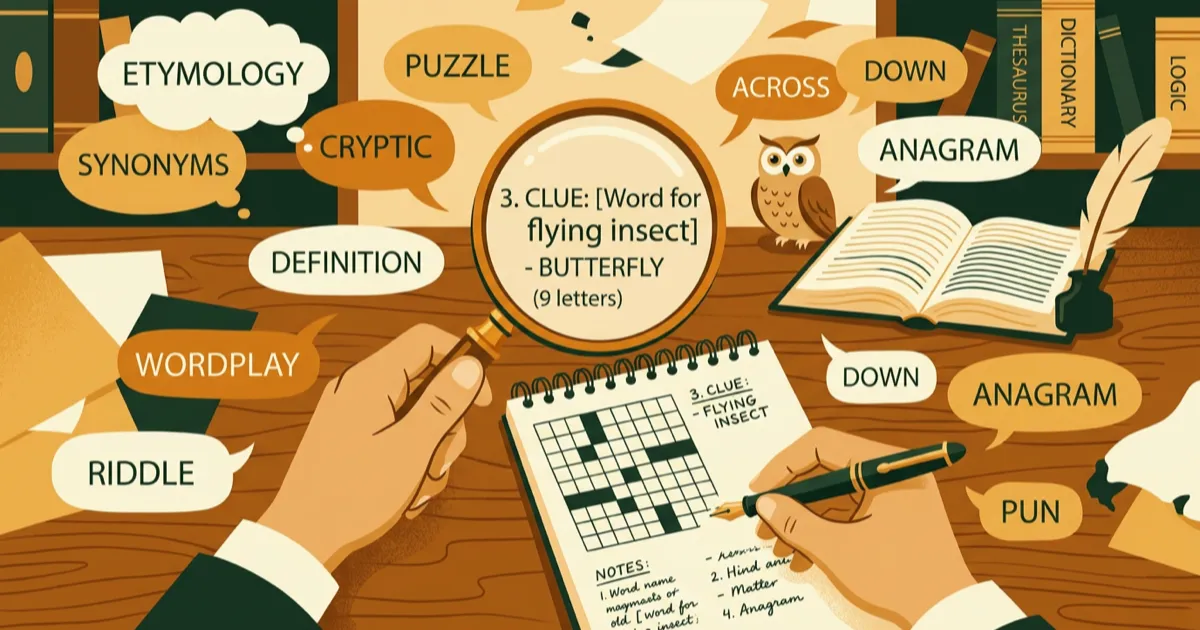
A crossword grid is only as good as its clues. Two puzzles can have identical grids and answers, but one is a joy to solve and the other is a chore — the difference is the clue-writing.
Whether you're creating your own crosswords or just want to understand what makes a great puzzle tick, here's a guide to the art of clue writing.
The Rules Every Clue Must Follow
1. One answer only
A clue must lead to exactly one defensible answer. "A color" is bad — it could be RED, BLUE, GREEN, or dozens of others. "The color of a clear sky" is better — BLUE is the only reasonable answer.
2. Fair to the solver
The solver should be able to reach the answer through logic, knowledge, or deduction. Obscure trivia with no path to the answer isn't a clue — it's a guessing game.
3. Grammatically consistent
The clue and answer must agree in part of speech, tense, and number. A plural clue requires a plural answer. A past-tense clue requires a past-tense answer. "Walked" → the answer ends in -ED.
4. Concise
Every word in a clue should be necessary. "A large body of water that is salty" is wordy. "Salty body of water" says the same thing in fewer words — and OCEAN is clear.
Clue Types: From Easiest to Hardest
Direct definition
The clue is a straightforward synonym or definition.
- "Joyful" → HAPPY
- "Ocean vessel" → SHIP
- "Capital of France" → PARIS
When to use: The backbone of any puzzle. Even hard crosswords need direct clues for shorter, common words.
Fill-in-the-blank
A phrase with a missing word.
- "___ of the Wild" → CALL
- "Ready, ___, go!" → SET
- "Once upon a ___" → TIME
When to use: As gimmes — easy clues that give solvers a foothold and confidence.
Synonym/one-word clue
A single word that means the same thing.
- "Courageous" → BRAVE
- "Nocturnal" → NIGHTLY
- "Ire" → ANGER
When to use: For clean, elegant cluing. The shorter the clue, the harder it tends to be (more possible answers).
Example/member-of-category
The clue names the category; the answer is a member.
- "Citrus fruit" → LEMON, LIME, or ORANGE (careful — this only works if crossing letters eliminate alternatives)
- "Noble gas" → NEON, ARGON, XENON (crossing letters disambiguate)
When to use: When crossing letters make the answer unambiguous.
Descriptive/contextual
A description that circles the answer.
- "It has 88 keys" → PIANO
- "Where the sun sets" → WEST
- "Break between acts" → INTERMISSION
When to use: When a simple synonym doesn't exist or feels too easy.
Abbreviation signals
When the clue contains an abbreviation or notes "(abbr.)," the answer is abbreviated too.
- "Doc's org." → AMA
- "Before noon (abbr.)" → AM
- "United Nations letters" → UN
When to use: For short fill words. Always signal that an abbreviation is expected.
Wordplay (question mark clues)
Puns, double meanings, and misdirection. A "?" at the end signals wordplay.
- "Current event?" → SWIM (current = water flow, not news)
- "Plant in a music store?" → ORGAN
- "Diamond figure?" → BATTER (baseball diamond, not jewelry)
When to use: Sparingly in Easy/Medium puzzles, frequently in Hard. The "?" is the solver's signal that the clue isn't literal.
Misdirection
The clue deliberately leads your thinking in the wrong direction.
- "It might be proper" → NOUN (you think of behavior, but it's grammar)
- "Lead role" → STAR (you might think of the metal lead)
- "Rock group?" → GEOLOGY (you think of a band)
When to use: The hallmark of expert clue-writing. What separates great puzzles from good ones.
Examples: Good vs. Bad Clues
| Answer | Bad Clue | Why It's Bad | Good Clue | Why It's Good |
|---|---|---|---|---|
| PIANO | Musical instrument | Too many possible answers | It has 88 keys | Specific, one answer |
| MARS | Planet | Could be any planet | The Red Planet | Unambiguous |
| ECHO | Sound | Way too vague | Canyon comeback? | Clever misdirection |
| NURSE | Medical professional | Could be doctor, surgeon... | Florence Nightingale's profession | Specific and educational |
| SAIL | Part of a boat | Multiple parts qualify | Wind catcher on a mast | Precise and visual |
Writing Clues for Your Own Puzzles
When creating a crossword with Grid Genius's Word List Builder or Freeform Editor, you write the clues. Here's how to make them good:
Start with a definition
For each answer, write a simple, accurate definition first. This is your baseline clue.
Add variety
Don't make every clue the same type. Mix:
- 40% direct definitions (backbone)
- 20% fill-in-the-blank (gimmes)
- 20% descriptive/contextual (engaging)
- 10% wordplay (challenge)
- 10% abbreviations/references (variety)
Match difficulty to audience
- For kids/beginners: Mostly fill-in-the-blank and direct definitions
- For casual solvers: Mix of definitions and descriptive clues
- For enthusiasts: Add wordplay and misdirection
Test for ambiguity
For every clue, ask: "Could this have a different answer of the same length?" If yes, add more specificity or let crossing letters disambiguate.
Or Let AI Write Your Clues
Grid Genius's AI generates clues automatically when you use AI puzzle generation. The AI writes accurate, thematically appropriate clues calibrated to your chosen difficulty:
- Easy: Direct definitions, common vocabulary
- Medium: Mixed styles, moderate vocabulary
- Hard: Wordplay, misdirection, specialized terms
And when you're solving, the AI Hint system demonstrates good clue-writing in action — each AI hint is essentially an alternative clue for the same answer, showing how the same word can be approached from multiple angles.
Ready to play?
AI-generated crossword puzzles on any topic — with smart AI hints that help you think, not just give away answers. Free to play, no sign-up required.
Start Playing Free